Overview
At a remote mining complex in Eastern Canada, a new haul road crossing required construction of a 65.6 ft (20 m) diameter culvert over a river. The crossing was designed to accommodate mining truck traffic rated at 400 tons, placing significant static and dynamic loading demands on the completed structure. The new route was intended to improve movement across the mining complex by shortening the required travel distance by 10 miles (16 km).
Construction of the culvert remained incomplete for several years because plastic deformation had developed in the structure. Before the crossing could be completed and placed under mining traffic, the project team needed to further investigate how loads would be transferred through the backfill to the culvert. The selected approach therefore needed to address the loading concern while allowing construction to resume without substantially changing the established backfill configuration.
Challenge
The primary engineering challenge was limiting the loads transferred to the culvert once the overall structure was completed and subjected to loading from mining trucks, each holding up to 400 tons of material. The previous plastic deformation raised concerns about proceeding with the original construction approach without additional measures above the culvert.
A reinforced concrete slab above the structure was identified as one possible means of minimizing the loads transferred to the culvert. The slab method would allow the project team to maintain the existing backfill thickness; however, the project was in a remote area where concrete is particularly expensive. This created additional constructability and cost constraints on the project and increased the value of a solution that could be incorporated directly into the granular backfill.
An alternative for construction therefore needed to increase the performance of the material above the culvert without requiring extensive modification to the original design. Ease of installation was also critical due to the remote site conditions and the need to finally complete a structure that had been delayed for several years.
Solution
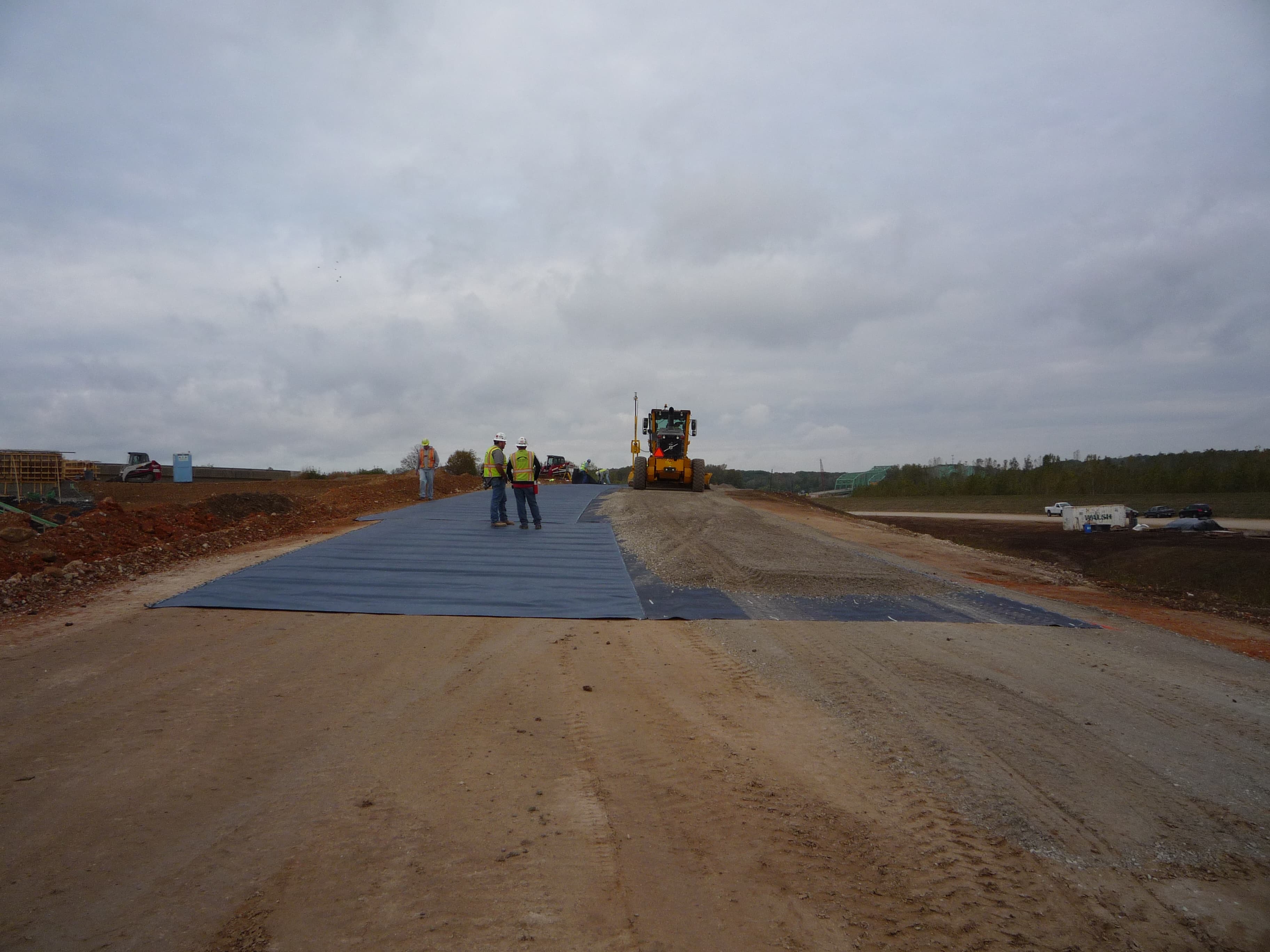
The project team incorporated geosynthetic reinforcement within the granular backfill above the culvert. The selected system used four layers of MIRAFI® H2Ri installed at 11.8 in. (300 mm) vertical spacing, with 16 rolls used for the project overall.
The reinforcement layers were introduced to increase the stiffness and soil arching of the granular backfill. This approach was intended to reduce the loads transferred through the backfill to the underlying culvert while retaining the established backfill thickness. Rather than introducing a substantially different structural element above the culvert, the geosynthetics could be integrated into the existing backfill configuration with minimal modification to the original design.
The use of MIRAFI H2Ri also provided a solution that was identified as cost-effective and comparatively easy to install for the remote project location. By reinforcing the granular material rather than relying on the proposed reinforced concrete slab, the project team could address the loading concern without the greater dependence on concrete associated with that alternative.
Following implementation of the reinforced backfill system, construction of the culvert was completed, and the haul road was placed into service. The completed crossing reduced travel distance within the mining complex by 10 miles (16 km). The project also reported efficiency gains associated with reduced travel time, fuel consumption, and mining truck operating hours, as well as reduced carbon emissions from construction.