Overview
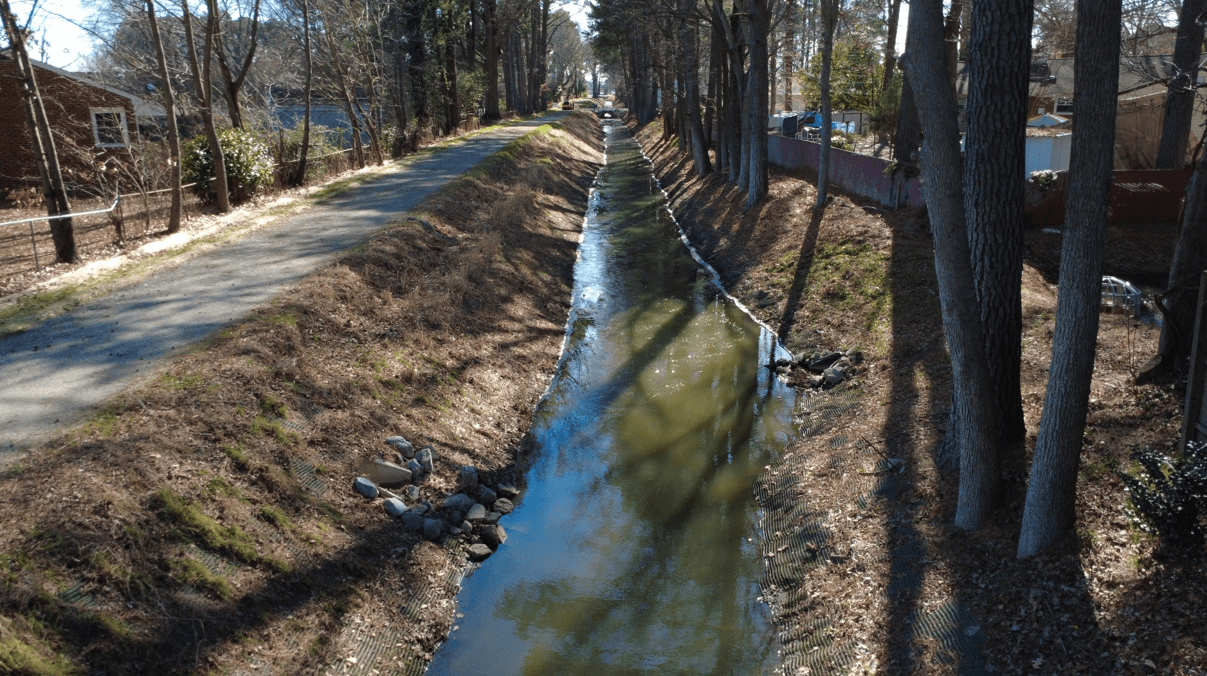
The City of Hampton, Virginia, is transforming an existing drainage canal as part of the Big Bethel Blueway Multi-Use Trail project. The project extends along the canal from the intersection of Big Bethel Road and Albany Drive toward Jaynes Road and Newmarket Creek. Its primary goals include increasing stormwater drainage capabilities while improving water quality before runoff reaches Newmarket Creek. The project also includes approximately 6,000 linear feet of multi-use trail to expand pedestrian and bicycle access along the Blueway for locals.
Moffat & Nichol designed the project, with Howard Brothers serving as the contractor and Exact Stormwater completing installation of the erosion control system. Rather than relying on exclusively conventional hard-armoring methods, the design incorporated PROPEX® Armormax® across the channel to provide erosion control and surficial slope stabilization while also supporting the establishment of vegetation. Approximately 25,000 yd2 (20,903.2 m2) of PROPEX Armormax and Type B1 Engineered Earth Anchors™ were specified for this project.
Challenge
The existing drainage canal showed several signs of hydraulic stress, from eroding banks to an incised channel bottom and bank overtopping. Over time, increasing impervious surfaces associated with urbanization had contributed to a greater volume of stormwater and velocity through the channel. This gradual change created a need for improved erosion protection as the City of Hampton expanded the canal’s stormwater management functions.
The design also needed to support broader objectives of the Blueway project. Riprap and concrete were considered as erosion control options, but the project team wanted a solution that could stabilize the channel while maintaining a vegetated surface. PROPEX Armormax was selected to support stormwater infiltration, water quality, and habitat while voiding continuous hard armoring along the treated channel. Previous successful PROPEX Armormax installations within the City of Hampton also contributed to the product selection.
Field conditions added another challenge during construction. Site preparation revealed a saturated channel bottom and localized areas of soft, mucky soils. The project plans required stabilization of slopes measuring 3H:1V and steeper, making reliable anchorage an important component of the system.
Weather created the most significant installation challenge. Multiple storm events occurred while work was under way, raising water levels to approximately four to six ft. in the channel. Some of these events occurred before vegetation had established, subjecting the installed system to hydraulic loading during an early stage of the project.
Solution
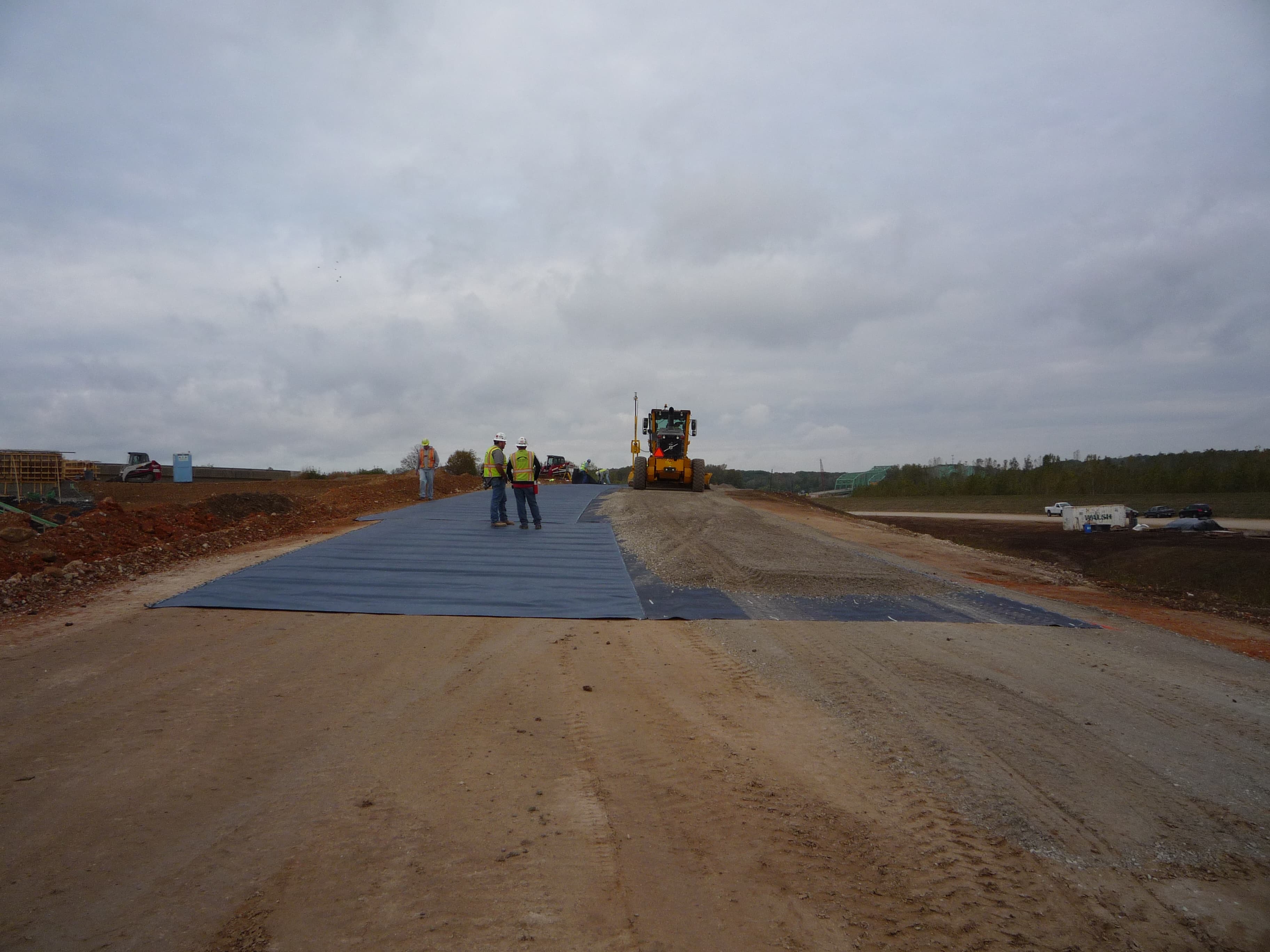
The project team installed PROPEX Armormax from bank to bank, including the channel bottom to stabilize the treated area with a reinforced vegetated system. PROPEX Armormax combines a high-performance turf reinforcement mat (HPTRM) with earth anchors to increase erosion resistance and maintain stable contact between the mat and underlying soil.
Installation began with grading to establish uniform slopes that were free of rocks and debris. Areas of soft and mucky soils created challenging conditions for anchorage- to combat this, the installation team utilized five ft. cable tendons with Type B1 earth anchors. The longer tendons allowed the anchors to extend beyond the softer, near-surface material to achieve improved pullout capacity.
Managing water within the active drainage channel remained critical throughout construction. Following several intense storm events, the contactor utilized sheet pile walls and pumps to dewater the work areas so that installation could continue. During a site assessment that followed a flood event that produced water depths of approximately four to six ft., the project team observed no erosion in the installed PROPEX Armormax areas, despite saturated slope conditions and the limited vegetation establishment at that stage.
The installation team also adjusted its workflow to improve efficiency. One crew installed PROPEX Pyramat® 75 HPTRM and securing pins, while a second crew followed to install the earth anchors. This approach allowed the crews to progress through the channel while maintaining the components required for the complete anchored system.
Post-installation observations documented the transition toward a vegetated channel. Three months after installation, a combination of established vegetation and exposed PROPEX Armormax remained visible along the channel. Approximately eight months post-installation, vegetation had established strongly in areas receiving sufficient sunlight, while the adjacent multi-use trail had also taken shape.
The Big Bethel Blueway project demonstrates how erosion control can play a key role in a broader stormwater resilience strategy. By integrating an anchored turf reinforcement system into the channel design, the project team addressed erosion and slope stability without relying solely on riprap and concrete. The completed installation provides protection for the channel while allowing vegetation to develop, and the larger Blueway project continues toward completion.