Saturated and unsaturated soils – what’s the difference?
In a landfill, containment decisions are often driven by prescriptive regulation. The design must meet the required standard, the system must be installed correctly, and the owner must demonstrate compliance. Those requirements matter, but the conversation is often framed around whether the facility meets the rule.
Mining is different.
In heap leach pads and other high-consequence containment applications, leakage is not only a regulatory concern. It is also a value concern, an operational concern, and a production concern. When solution escapes through a defect in the barrier system, it’s likely that the operator will face more than an environmental risk. They also lose recoverable mineral value, process efficiency, water, reagents, and confidence in the integrity of the system.
Rather than asking “Do you care if it leaks,” it’s more prudent to ask “Do you care how much it leaks? For heap leach operations, the answer is yes.
Heap leach pads are designed to contain and convey pregnant, process solutions which have percolated through stacked ore so valuable minerals can be recovered. The containment system is expected to perform under demanding conditions, including large loads, aggressive chemistry, variable temperatures, construction traffic, cover materials, drainage layers, and long operating cycles.
When the barrier system contains defects, the consequences can extend beyond the barrier system. Solution loss can affect recovery. Localized leakage can increase environmental exposure. Undetected defects can remain active after cover layers are placed, making repair more complicated and expensive. Despite best efforts, cover layers are often found to be a leading source of damage to the barrier system itself. Even small defects can become costly when they are not found early.
This is what separates many mining containment applications from more prescriptive waste containment environments. In mining, the liquid being contained often has direct economic value. Losing it is not just a compliance challenge. It is a business challenge.
For owners and operators, the barrier system is not a passive layer buried below the operation. It is part of the recovery system. Its performance helps protect the site, the environment, and the economics of the project.
A well-designed geomembrane barrier system can provide exceptional containment performance, but no project should assume that installation is automatically defect-free. Geomembranes are installed across large areas, often in remote locations and challenging site conditions. Panels must be deployed, welded, tested, covered, and protected while other construction activities continue around them.
Damage can occur from subgrade irregularities, equipment traffic, aggregate placement, installation stresses, welding issues, punctures, or construction sequencing. Some defects are visible during installation. Others are not. Once cover soil, drainage stone, or ore is placed above the geomembrane, the ability to visually inspect the barrier system is greatly reduced.
That is why electrical leak location surveys (ELLs) have become an important part of construction quality assurance for critical containment systems. ELL methods help identify defects that may otherwise remain hidden. When defects can be located and repaired before full operation, the owner has a much better opportunity to reduce leakage risk before it becomes an operational problem.
But an ELL is only as effective as the system allows it to be.
For heap leach pads, leak location cannot be treated as an afterthought. The barrier system should be designed from the beginning to support efficient, reliable testing during construction and after cover layers are placed.
Traditional ELL surveys have struggled with conductivity of the material beneath the geomembrane such as gravel, sand, drainage net and air voids that can exist under wrinkles. A second challenge is that intimate contact between the geomembrane and conductive substrate is required for successful leak detection. This can be difficult to achieve with frozen, dry or low moisture subgrades and is not possible in areas where the geomembrane is wrinkled.
That is where conductive geomembranes provide an important advantage.
A conductive geomembrane includes a conductive layer that supports effective electrical leak location methods and allows the entire surface of the geomembrane to be spark tested. This allows defects to be detected more efficiently across both exposed and covered applications, depending on the survey method and site conditions. For a heap leach pad, that capability matters because the barrier system may be covered soon after installation. Once that happens, the opportunity to locate and repair defects becomes more difficult without a system designed for post-cover testing.
In high-consequence containment, the question is not whether a geomembrane was installed. The question is whether the installed geomembrane can be verified as installed properly.
A conductive liner helps make that verification process more practical. It supports more effective construction quality assurance, helps reduce uncertainty after cover placement, and gives owners and engineers better information about the actual condition of the barrier system. In many applications, the liner can be retested as often as necessary to ensure its integrity over time.
For mining operators, that information has value. Knowing where defects are located allows targeted repair, and reducing undetected leakage helps protect process solutions. Improving ELL survey efficiency can reduce delays that inhibit mining operations. Most importantly, it helps shift the project from assumption-based containment to verified containment.
Material color also matters.
Black geomembranes absorb heat, which can contribute to thermal expansion, slack, and wrinkling during installation. Wrinkles can complicate construction, affect intimate contact with underlying materials, create stress points, and make barrier systems harder to cover consistently. In critical containment applications, those field realities matter.
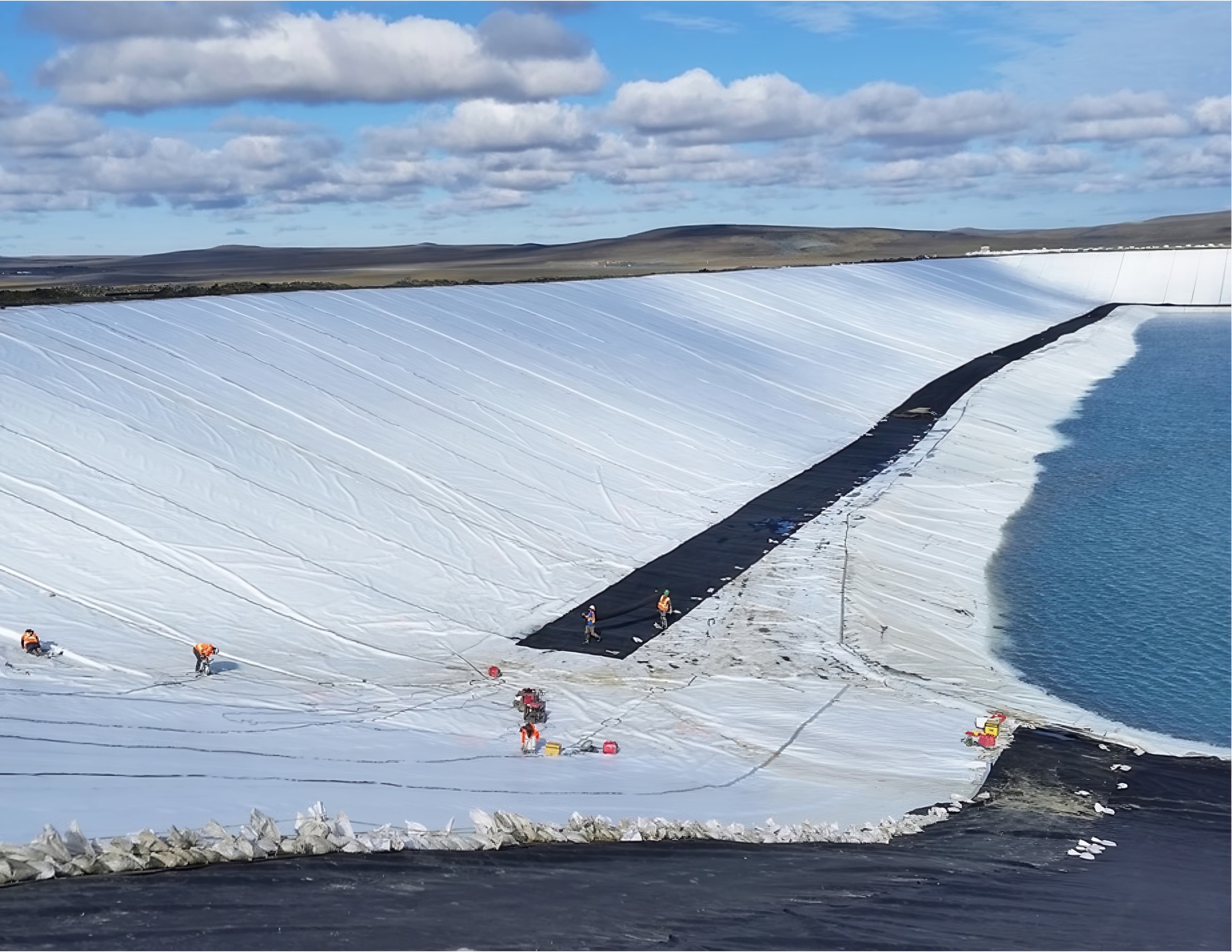
White-surfaced geomembranes help reduce heat absorption and heat degradation in addition to providing better visibility during installation. The white finish maintains a cooler temperature that reduces contraction and expansion of the geomembrane by up to 40 percent. This protects the mechanical properties and extends the service life of the geomembrane. A lighter surface can also make wrinkles, damage, scoring, and impact damage easier to see. It can also help crews work with a liner surface that is less affected by heat buildup than a traditional black surface.
For heap leach pads, a change in material color can support better installation control. Better visibility helps crews identify issues earlier. Reduced thermal movement can support more manageable panel placement and cover operations. These advantages do not replace proper design, installation, or quality assurance, but they can make a meaningful difference in field performance.
A geomembrane in a heap leach pad must do more than separate process solution from the environment. It must support the economics of the operation, perform under load, and withstand site conditions. It must be installable, testable, and repairable.
That is why high-performance, white, conductive geomembranes deserve a central role in heap leach pad design.
The white surface supports field visibility and thermal management. The conductive layer supports efficient electrical leak location. Together, these features help owners, engineers, and installers move beyond minimum. This distinction matters in mining because a barrier system that cannot be effectively tested after cover placement may leave too much uncertainty in the system. A defect that is not located becomes a recurring source of solution loss. A containment strategy that focuses only on initial installation may miss the larger operational question: how much leakage can the project afford?
For many heap leach operations, the answer is very little.
GSE® geomembranes are designed for demanding containment applications where performance cannot be compromised. In heap leach pads, process ponds, tailings facilities, evaporation ponds, and other mining infrastructure, the barrier system plays a direct role in environmental protection and operational efficiency.
GSE high-performance white surfaced geomembranes and GSE Leak Location Conductive geomembranes help support this need by combining barrier performance with practical field advantages. These solutions are designed to help improve installation control, support electrical leak location surveys, and provide the durability required for critical containment applications.
Of course, no geomembrane works alone. Successful heap leach pad performance depends on a complete system, including proper subgrade preparation, cushioning and protection layers, drainage design, installation quality, welding, testing, cover placement, and long-term operational management. But the geomembrane remains the primary barrier. Its material properties, surface characteristics, and ability to support leak location can directly affect the performance of the entire system.
When the liquid being contained has value, leakage becomes measurable in more ways than one. It can be measured in lost solution and recovery, added remediation, delayed operations, and reduced confidence.
Heap leach pad design should begin with a clear understanding of what is at stake.
If you care how much it leaks, you care about verification.
If you care about verification, you need a geomembrane designed to support it.
And if you care about protecting recovery, reducing risk, and improving containment confidence, high-performance white conductive geomembranes deserve a place in the conversation.