
Lake bank stabilization at Vivid Shores
At Vivid Shores in Bonita Springs, Florida, PROPEX® Armormax®, MIRAFI® FW403 and MIRAFI 140N stabilize lake banks exposed to wind-driven wave erosion. Completed sections are performing as designed.
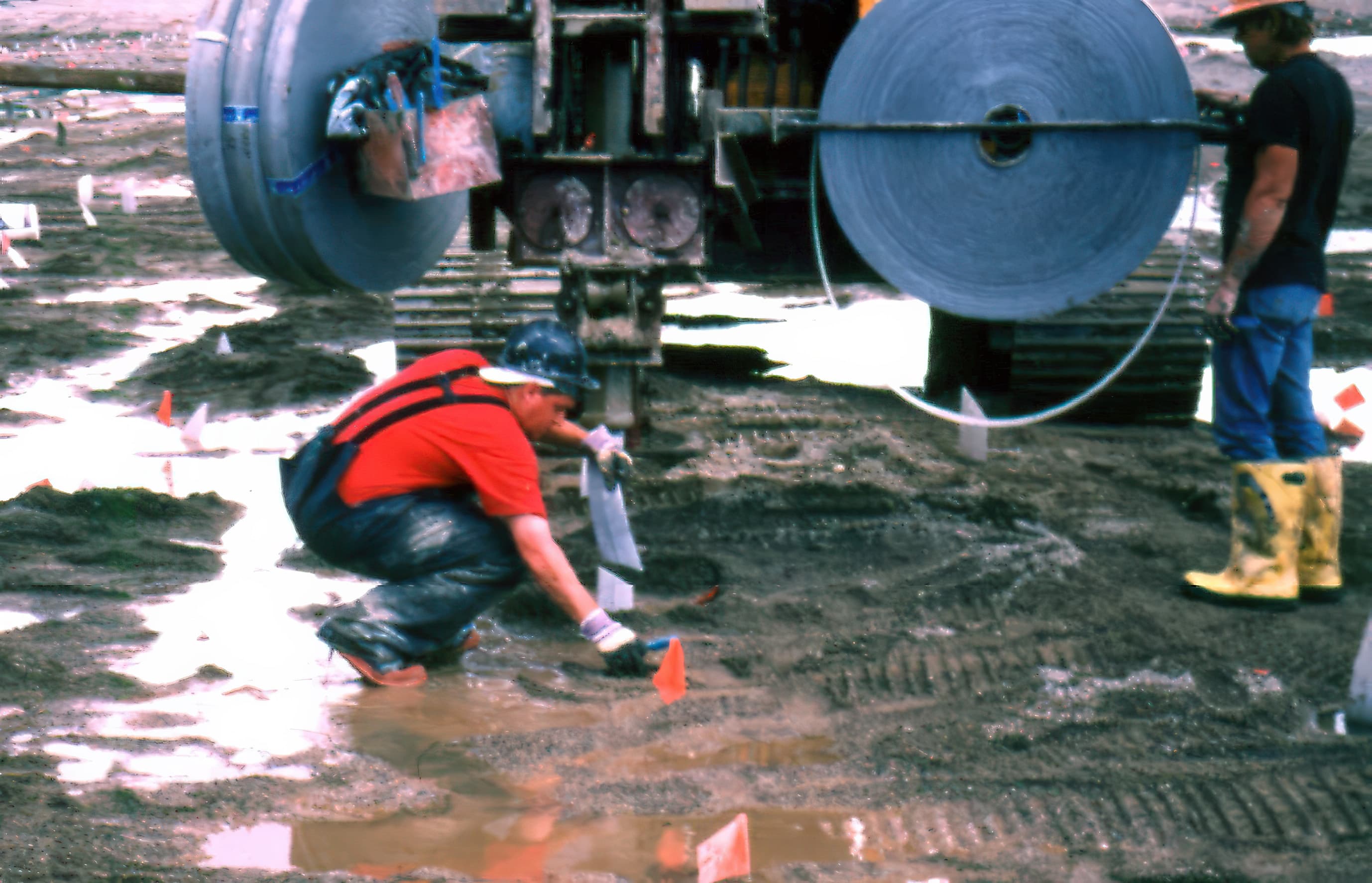
PVDs were installed through the platform on a 2 m triangular pattern to reach the sludge base.
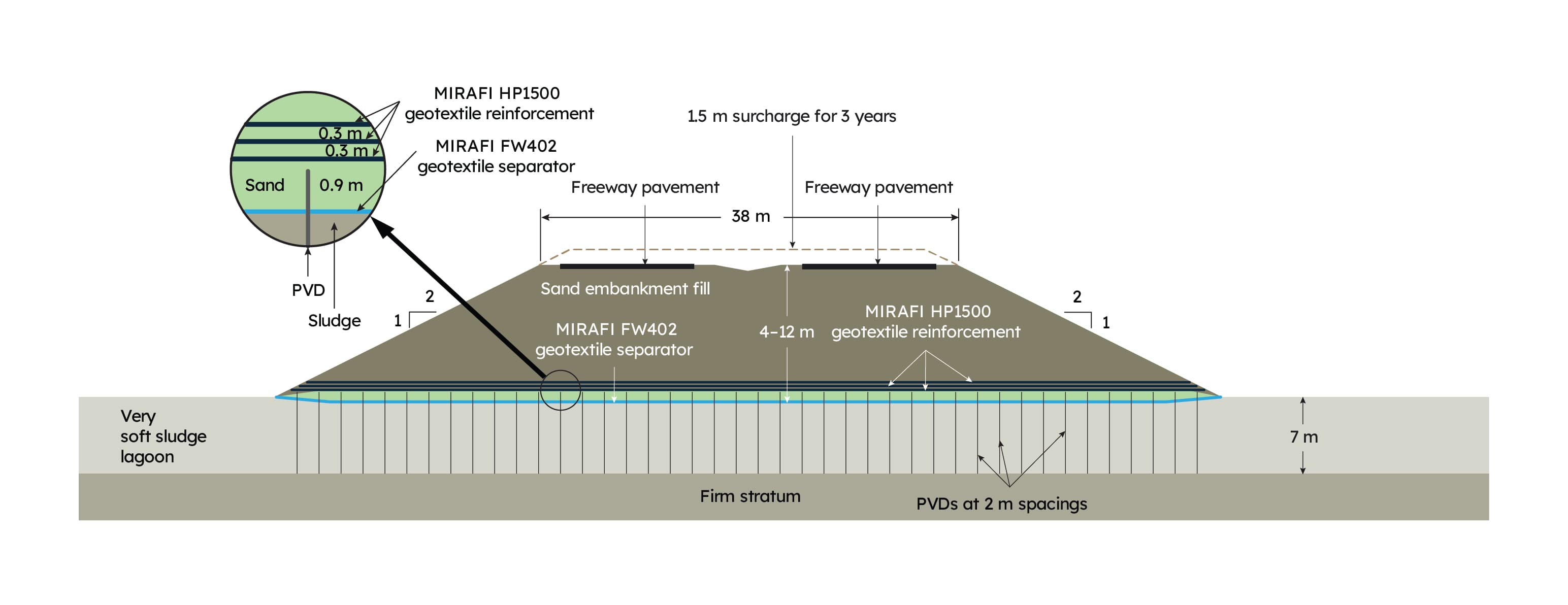
Typical cross section through the basal reinforced embankment
Lake bank stabilization at Vivid Shores
At Vivid Shores in Bonita Springs, Florida, PROPEX® Armormax®, MIRAFI® FW403 and MIRAFI 140N stabilize lake banks exposed to wind-driven wave erosion. Completed sections are performing as designed.
Crowne Point Country Club Case Study
Crowne Point Country Club rehabilitated a deteriorated Vermont access road with MIRAFI H2Ri, using active moisture management to address saturated soils, frost-related distress and subgrade instability.

GSE HD geomembrane lined salt ponds ensure long-term brine containment
GSE® HD geomembrane lined over 3.4 million m² of evaporation ponds to prevent brine seepage under extreme heat and UV exposure. This continuous barrier eliminated salt discharge and protected the surrounding environment.
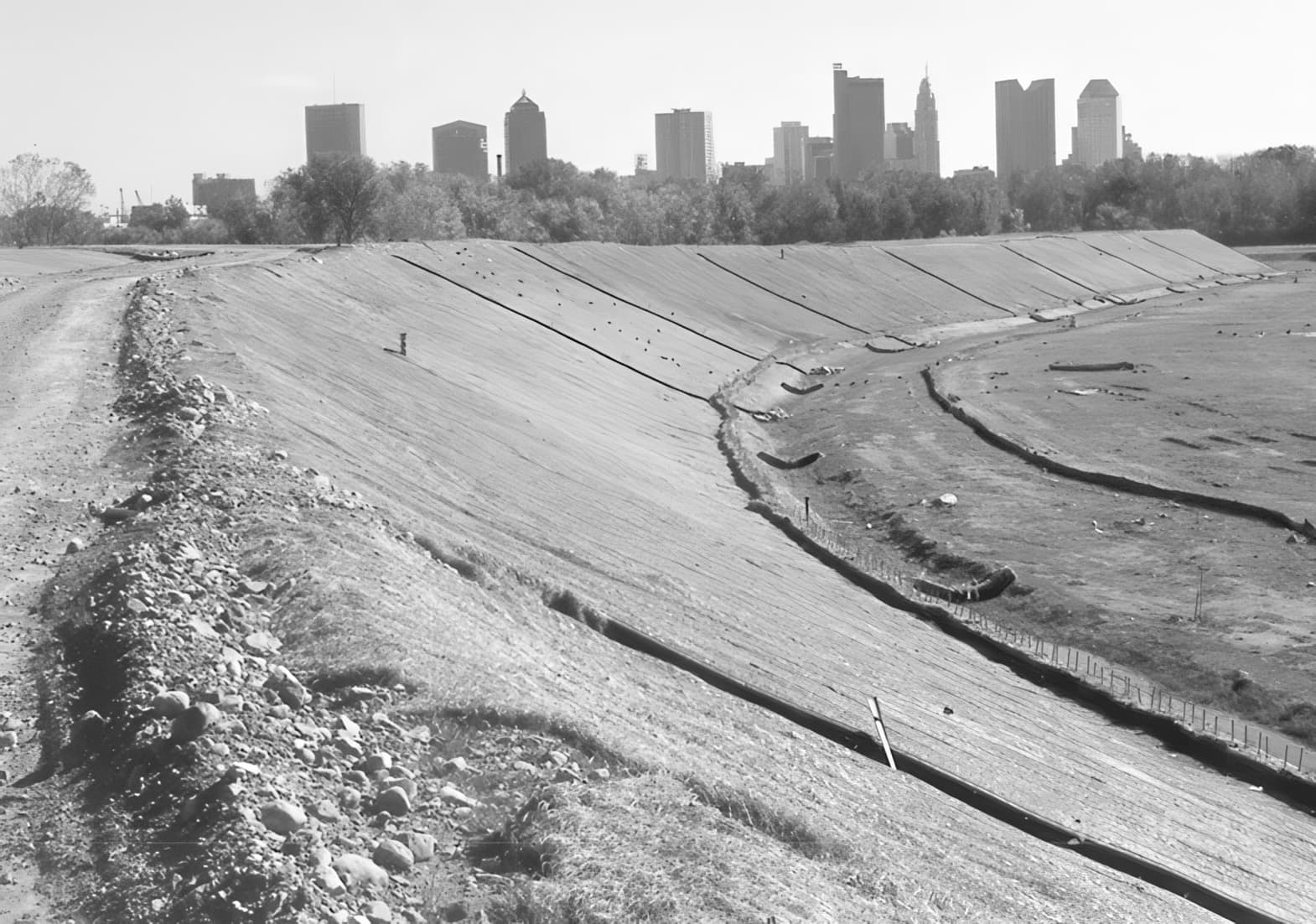
The extension of a 6-lane interstate freeway, I-670, into downtown Columbus, Ohio was required to eliminate a major highway bottleneck. The only alignment that was available was across a 1 km stretch of old gravel pits that had been filled with water softening sludge from an adjacent water treatment plant in the 1970s. Probes identified the sludge to be up to 7 m deep. The sludge is a by-product of the water treatment process and consists of aluminium sulphate, lime, soda ash, and alum, and has the consistency of toothpaste. The sludge had a very high moisture content, ranging between 200 percent and 300 percent, and a pH = 10. Undrained shear strengths ranged from 5 to 10 kPa, increasing with depth. The sludge was highly compressible with a compression index of 3.1 and a recompression index of 0.05. The permeability of the sludge was between 1×10⁻⁷ and 1×10⁻⁸ m/sec in both the horizontal and vertical directions.
Because of environmental concerns, the sludge could not be removed from site. Thus, a geosynthetic reinforced embankment, constructed across the top of the sludge, proved to be the only cost-effective option. The required height of the embankment ranged between 4 m and 12 m. To prove the design concept and derive accurate engineering performance parameters, a fully instrumented test fill was constructed with varying prefabricated vertical drain (PVD) spacings and varying geosynthetic reinforcement, and this was monitored for 2 years.
The geosynthetic reinforcement for the final embankment design was determined using a limit equilibrium approach. The design allowed for three layers of MIRAFI® HP-Series geotextile reinforcement at the base of the embankment to develop the required short-term stability. MIRAFI HP is a high modulus, woven polypropylene geotextile with a tensile strength of 190 kN/m in the longitudinal direction. It was considered that a polypropylene geotextile would be better suited for this application because of the potentially harmful effects of the high pH sludge material on geotextile reinforcement durability. To construct the embankment, a working platform was first constructed across the sludge material. The working platform consisted of a MIRAFI FW402 woven polypropylene geotextile separator installed across the sludge, with a 1 m thick sand layer on top to perform the dual role of a working platform and the drainage layer for the PVDs. The MIRAFI FW402 geotextile separator was fabricated into wide panels onsite and then pulled across the sludge surface using ropes and small excavators. The sand fill was then spread across the geotextile separator to a thickness of 1 m using lightweight equipment. Following construction of the working platform, the PVDs were installed, on a 2 m triangular pattern, through the working platform to the base of the sludge layer.
Following installation of the PVDs, the first MIRAFI HP geotextile reinforcement layer was placed across the width of the embankment, with 300 mm of sand fill placed on top. This process was repeated for the second MIRAFI HP geotextile reinforcement layer, with the third geotextile reinforcement layer placed on top of this. The geotextile reinforcement layers were placed without wrinkles and were seamed together laterally into continuous sheets by means of onsite sewing. Construction of the embankment to a maximum 12 m in height involved staged construction (even with the presence of PVDs) where the embankment fill loading was matched with a gain in shear strength of the sludge, with the basal geotextile reinforcement providing the required short-term stability. This staged construction was carried out with the aid of extensive instrumentation. The embankment fill, along with a 1.5 m surcharge, was placed in a controlled manner over a 15-month period. Large settlements of up to 2.8 m have been recorded under the 12 m high embankment section prior to pavement placement. This corresponds to 35 percent of the original sludge thickness. At the same time, geotextile reinforcement strains ranging between 1 percent and 4 percent have been recorded. While settlements have been large, five years after placement of the concrete pavement, the roadway section over the sludge is performing similarly to the pavements over non-sludge areas.