Do you care if it leaks?
Once a landfill reaches capacity, operators must either close the site or invest in costly new locations. As urban growth continues and available land becomes scarce, landfill operators face increasing pressure to maximize capacity without acquiring new property. Vertical expansion – increasing capacity by building upward rather that outward – allows existing landfills to accommodate more waste by increasing height, provided structural stability and environmental safety are maintained. In addition to conserving land, this practice, also referred to as “piggyback landfills” reduces land-use permitting challenges and environmental impacts associated with enlarging facility footprints.
Geosynthetics can help address the challenges that come with construction over an existing landfill. They optimize vertical expansion by reinforcing and protecting landfill structures and provide slope stability that becomes critical when maximizing depths.
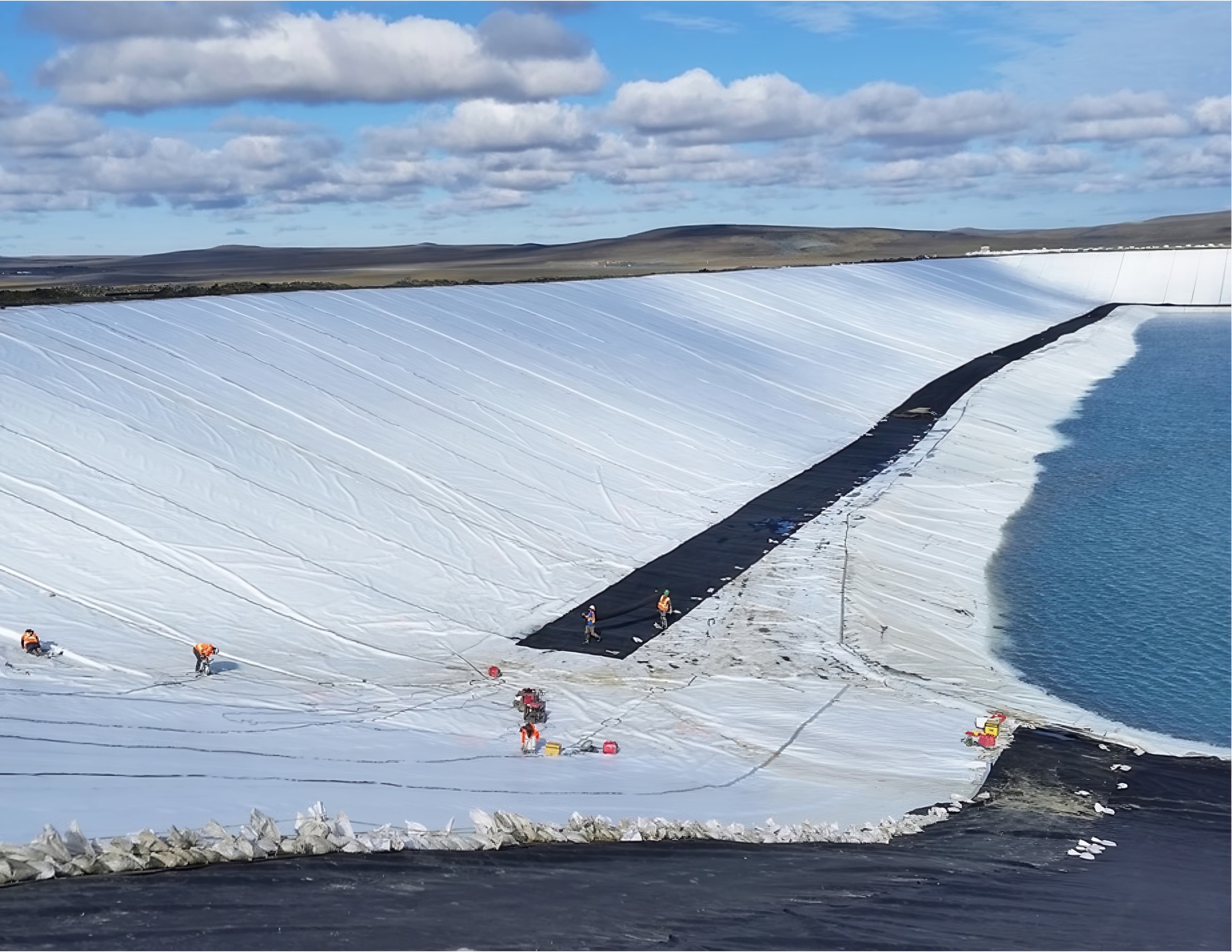
Geomembranes are a critical component in the design of reliable containment solutions, providing an effective barrier system with very low permeability values. However, potential sources of slope failure in a landfill are between geosynthetic components and/or between the geosynthetic and the subgrade. Incorporating a geomembrane liner with a textured surface can improve the interface friction between both liners in multilayered systems and the liner and the subgrade. Textured geomembranes provide a higher friction angle and shear strength than smooth geomembranes, which are essential for vertical expansion.
Solmax engineered an extra, extra rough textured (XXRT) option for its GSE® geomembrane to be paired with BENTOLINER® GCL, thus creating a system that can push the upper limits of shear strength and slope stability. The XXRT allows for 20 percent to 30 percent increased shear strength compared to standard textured geomembranes.
Testing is commonly performed to determine the critical combination of loading and angle. The Technical Note, Interface shear strength of geomembrane materials, takes a closer look at a typical direct shear test.
In addition to better performance, textured geomembranes provide a safer, more stable walking surface on steep slopes for installers.
As mentioned, geosynthetic clay liners (GCLs) are commonly used in landfill liner systems to provide a low-permeability barrier to prevent leachate from infiltrating soil and groundwater. GCLs are engineered with bentonite, allowing the material to rapidly hydrate and swell to create an effective barrier.
However, bentonite alone does not provide the shear resistance required in high-load landfills and vertical expansion. In these applications, a GCL with high peel strength is necessary. High peel GCL is a high needle-punching bond strength (ASTM D6496) between the carrier and the cover geotextile. For example, BENTOLINER NW is a needle punched reinforced composite GCL comprised of a uniform layer of granular sodium bentonite encapsulated between a nonwoven and a scrim-nonwoven geotextile for dimensional stability. The greater number of reinforcing fibers directly correlates to higher internal shear strength, allowing for steeper slope design and improved performance under high stress. This allows designs to go steeper and deeper without special fill operations.
Geosynthetic drainage composites are used in landfill lining systems to prevent leachate infiltration into groundwater. In some cases, vertical expansion can create a rise in the leachate level under the overburdened load, thus creating slope instability and reduction of shear strength. Without proper venting, the flow of gas in the old waste can have the same effect. Using a geosynthetic drainage system beneath the passive layer, can facilitate efficient gas venting to reduce hydrostatic pressure. This reduction of pressure supports the structural integrity of the expanded landfill section.
Using a geosynthetic drainage system in a vertical expansion can also save air space, allowing for more waste to be collected in the landfill. Traditionally 12 inches of sand or aggregate is required for a primary drainage layer in a landfill application, however a drainage geosynthetic can replace this layer. This will reduce the air space consumed by up to 98 percent. For a closer look, review the Technical Note Drainage Geosynthetics Replace Natural Drainage Materials.
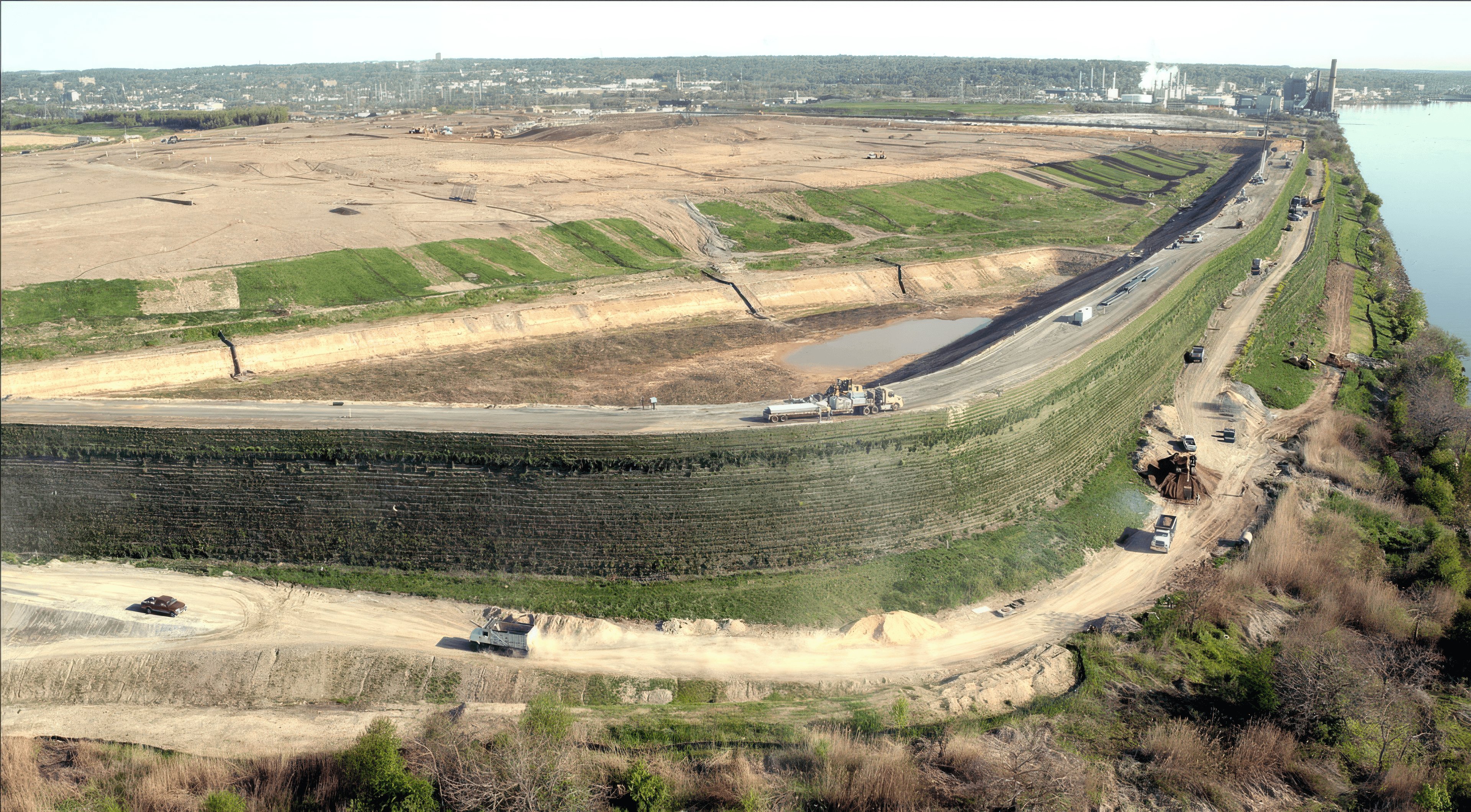
A key factor in vertical expansion of landfills is the ability to increase airspace. Mechanically Stabilized Earth (MSE) walls or berms are used to extend the landfill space up, rather than out. These berms are constructed by reinforcing compacted soil with geogrids, allowing for stable slopes and additional weight.
When the Cherry Island Landfill in Wilmington, DE needed additional capacity to extend its service life by 25 years, vertical expansion was the only option because the landfill is surrounded by rivers and interstates. A combination of MIRAGRID® 20XT geogrid and MIRAGRID Miramesh was used to construct a 75 ft tall MSE berm, which is one of the largest geosynthetic berms constructed for landfill expansion history.
Using a geosynthetic reinforced MSE berm in landfill expansion can help create additional capacity over the existing landfill footprint, cost less than traditional earthen embankments, and can increase capacity without increasing closure costs.
Vertical expansion is a smart strategy for landfill operators facing space constraints. By leveraging geosynthetics, engineers can design safe, stable, and environmentally responsible solutions that maximize capacity without expanding the footprint.