Overview
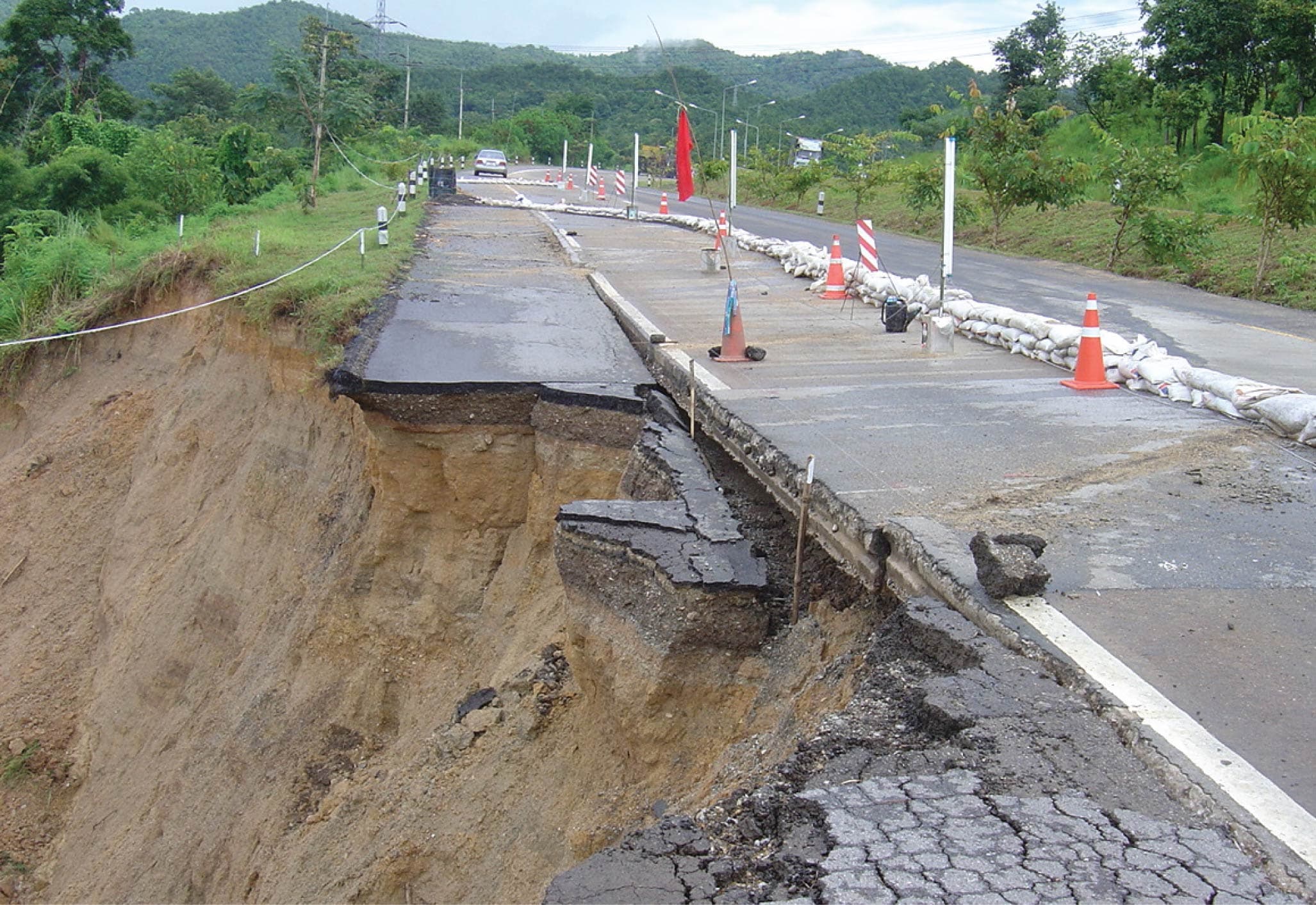
The road connecting Khun Tan and Lampoon in Northern Thailand is vital for their economic link. Unfortunately, the embankment at KM 11 failed, causing significant traffic disruptions and posing risks to road users. After considering various repair options, the Thailand Department of Highways decided to use geogrid soil reinforcement materials for the slope repair.
Solution
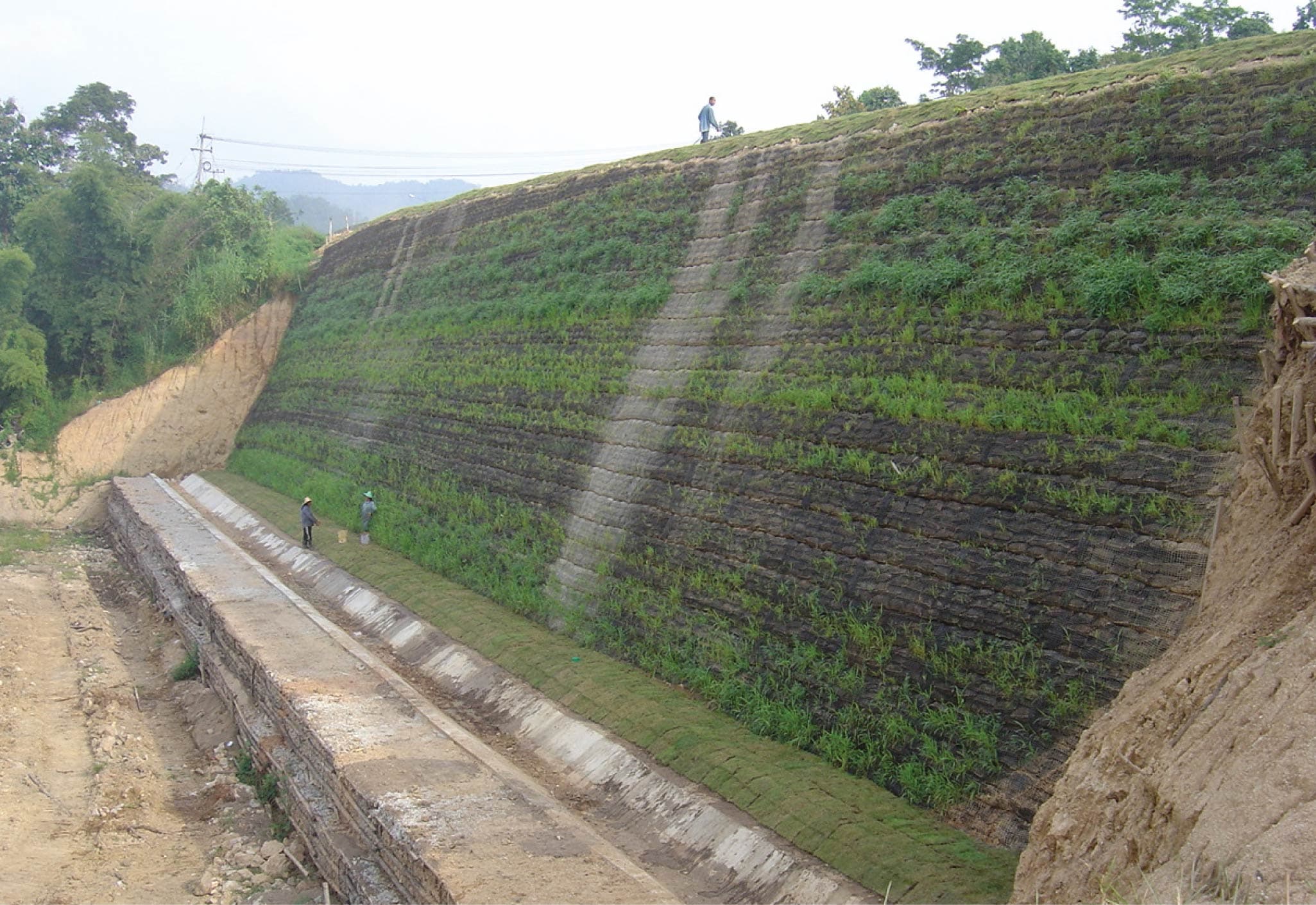
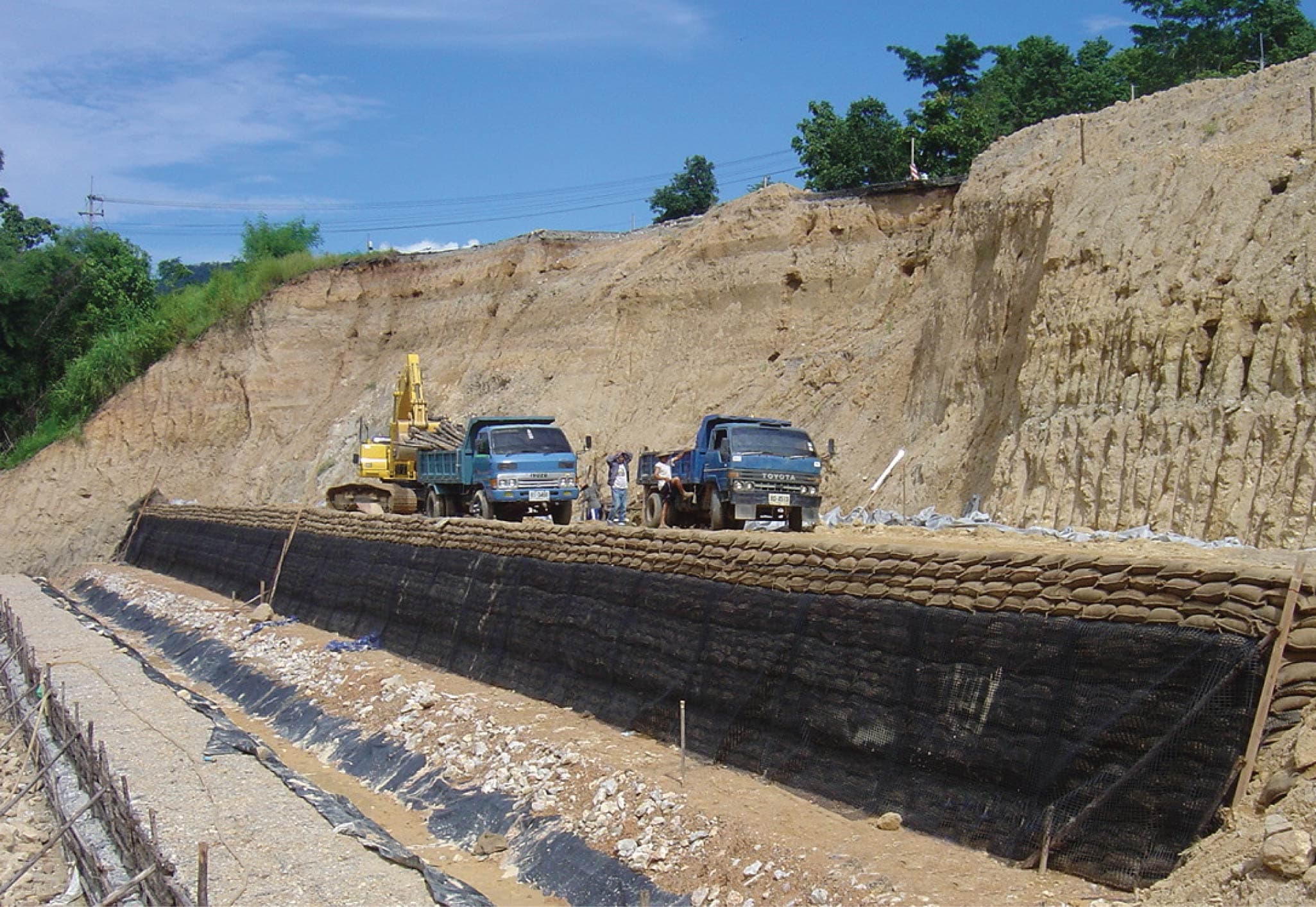
The failed slope was trimmed to solid ground. The embankment's toe was strengthened with gabions, and a stable foundation was built behind them. MIRAGRID® GX geogrids were installed at 500 mm (19.7 in) intervals to reinforce the backfill material. The slope profile was created by wrapping the geogrids around jute geobags filled with humus and grass seeds. This construction method offers several advantages. It provides local employment opportunities and allows for the practical construction of uniformly steep slopes. During the following rainy season, the bags retain moisture, aiding the germination of grass seeds.
To prevent subsoil water seepage, a drainage layer consisting of stone aggregate wrapped with MIRAFI® Polyfelt® geotextiles was installed along the back of the structure. The slope was constructed as a single 10 m (32.8 feet) high berm with an average slope angle of 70 degrees.
The repair work, carried out by a local construction contractor, was completed within four months. Vegetation growth was visible within 2-3 weeks after the top layer was finished.
This repair method is particularly suitable for failed slopes and embankments in remote rural areas. The use of geobags as facing formwork allows for the construction of slope profiles that blend seamlessly with the surrounding slopes. It is also flexible enough to accommodate structures like culverts. Local labor with medium to light construction equipment can be employed for the construction.
Most provincial engineers are capable of supervising such construction projects. As long as the soil backfill is properly compacted and the reinforcement geosynthetics are correctly installed, the resulting reinforced soil structure will be stable and secure. Once the vegetation is established, the slope will blend in with the surrounding vegetation and be indistinguishable.