Overview
A reclamation project in Malacca City, Malaysia, sought to reclaim 112 acres of land for commercial and industrial development. Located at the mouth of the Malacca River and facing the Strait of Malacca, the site lies along the main shipping channel between the Indian and Pacific Oceans. The Strait of Malacca is recognized as one of the world’s most significant shipping routes. The project required the construction of a containment bund to facilitate land reclamation activities. The initial design called for the placement of marine sand, construction of a containment bund, and installation of rock armour protection along the seaward boundary. However, challenging site conditions prevented the project from proceeding as planned. An alternative geosynthetic approach was required to advance the project, maintain stability, and minimize environmental impacts.
Challenge
The original methodology relied on traditional sand bund construction protected by rock armour. In 2023, construction commenced with dump trucks depositing marine sand excavated approximately 12 km southwest from the site to meet design levels, while bulldozers and wheel loaders worked to level the sand into a containment structure.
After placing more than 200 m³ of sand, contractors encountered the project’s primary geotechnical challenge within the first 5 m section of the bund: a seabed consisting of approximately 10 m of extremely soft marine clay that absorbed the dumped sand. While the bund maintained its position during high tide, it was observed to be almost completely lost during subsequent low tides.
The mechanical placement of sand further disturbed the weak foundation soils, resulting in significant sand loss and seabed heaving. The Department of Environment (DOE) ordered reclamation activities to be suspended, due to concerns that the excess sediment loss and mud heaving could negatively impact surrounding seawater quality.
An alternative solution capable of providing stability and allowing construction to move forward was required.
Solution
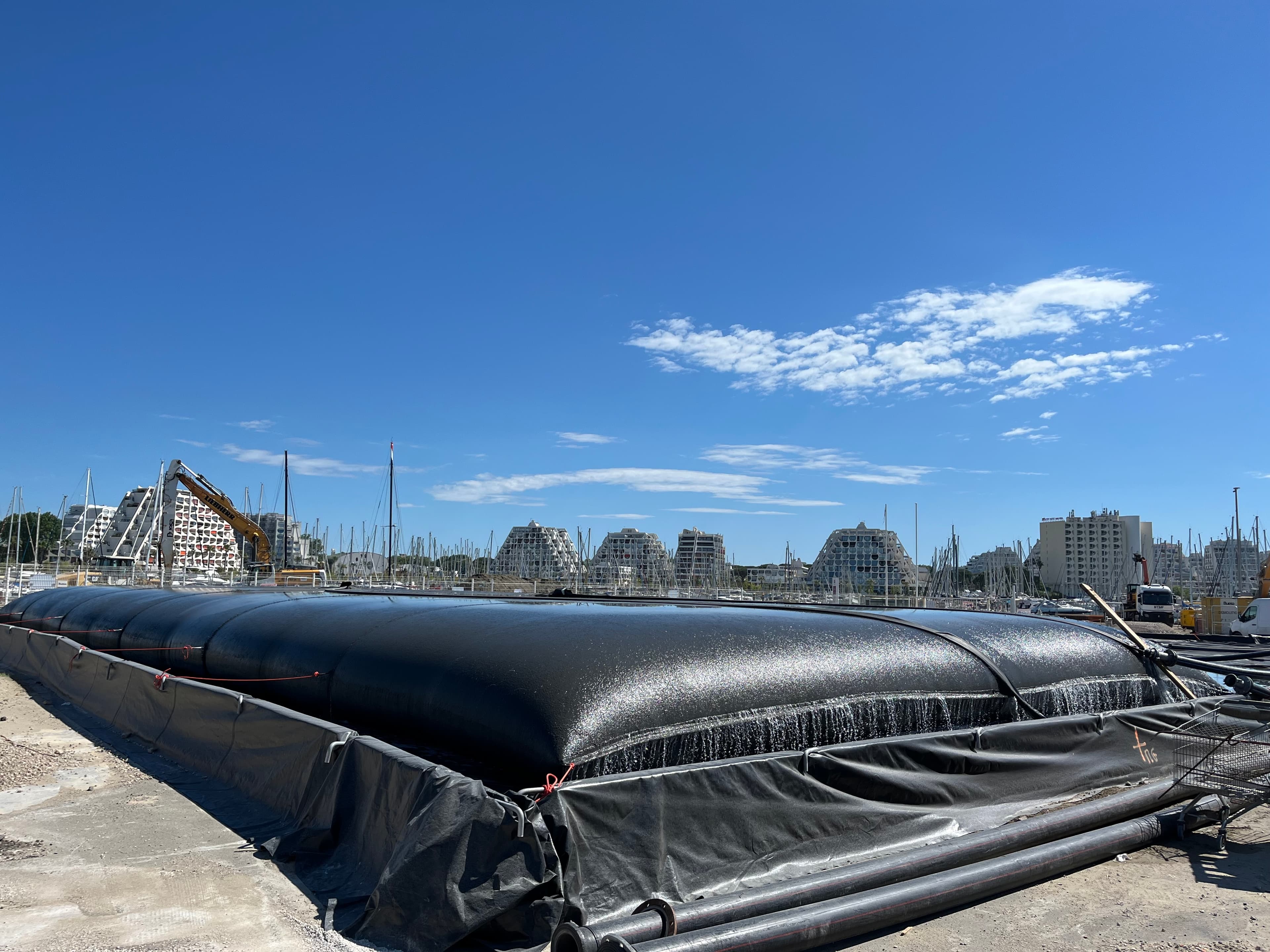
Rather than dumping additional sand onto a weak seabed and risking project delays, contractors selected an alternative approach and used GEOTUBE® Marine engineered tubes fabricated with GEOTUBE GT1000M to construct a containment bund. Forming a 600 m-long containment structure, the tubes were hydraulically filled with sand slurry, allowing sand to accumulate gradually and minimize disturbances to the soft marine clay foundation. As sand was retained within the tubes and seawater was discharged, construction was able to proceed without the instability associated with conventional sand placement.
Three layers of GEOTUBE Marine containment tubes were installed with two layers of MIRAFI® PET1200-50 high strength woven geotextile to provide basal reinforcement. The first MIRAFI PET1200-50 layer was installed at the seabed level, followed by the first 15.7 m-circumference GEOTUBE containment tube. Once reclamation fill reached approximately 2.3 m in height, the second MIRAFI PET1200-50 layer was installed, followed by the second and third layers of GEOTUBE containment tubes. A smaller, 9.5 m tube made with GEOTUBE GT500M was installed at the toe of the structure for scour protection.
Upon completion of the tube installation, rock armour was placed over the GEOTUBE containment structure as permanent protection. Prior to the placement of the rock armour, a layer of MIRAFI PET1200-50 was installed over the toe and extends across the containment tube structure to provide stability during the final rock placement works.
By combining GEOTUBE Marine containment systems and MIRAFI PET1200-50 basal reinforcement, the redesigned containment system provided the stability needed to construct a bund on soft marine clay. The design modification reduced the quantity of sand and rock required in the original approach, enabling reclamation activities to move forward through a more efficient and cost-effective alternative to traditional construction methods.