Overview
Intent upon meeting its climate commitments as well as responding to escalating power demands, the India government is aggressively pursuing projects that will facilitate the country’s transition to clean energy. Included in these efforts is a 1.3 megawatt (MW) solar farm project installed in Nagari, Andhra Pradesh. Intended to produce captive power for household consumption, the project utilizes bifacial solar panels that capture sunlight from both sides of the panels—direct sunlight on the front and reflected/diffused light on the back—which can increase total energy density by 5%-to-20% without requiring additional land.
Another of the project’s objectives is to evaluate and monitor how the deployment of Solmax’s GEOLUX® reflective membrane enhances the Albedo effect, resulting in bifacial and energy gains. A single inverter was used to obtain the necessary measurement, determining how much of the direct current (DC) stored by the solar panels is converted into the alternating current (AC) required for household use. This information would also allow for the projection of return on investment (ROI).
Solmax client, Confab Pumps in Coimbatore, Tamil Nadu, India, was the contractor and pump supplier, working with the operator of this solar farm project.
Challenge
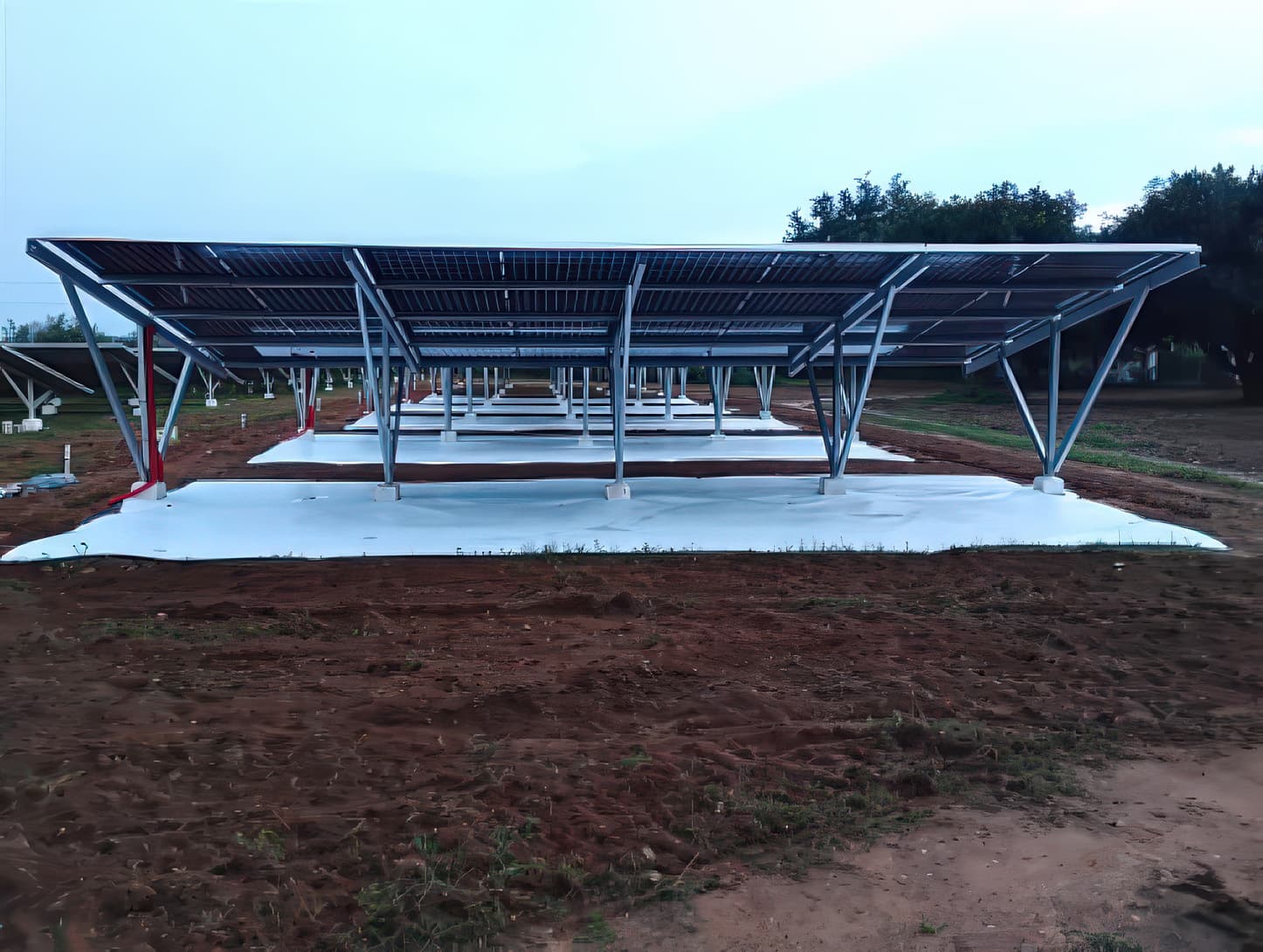
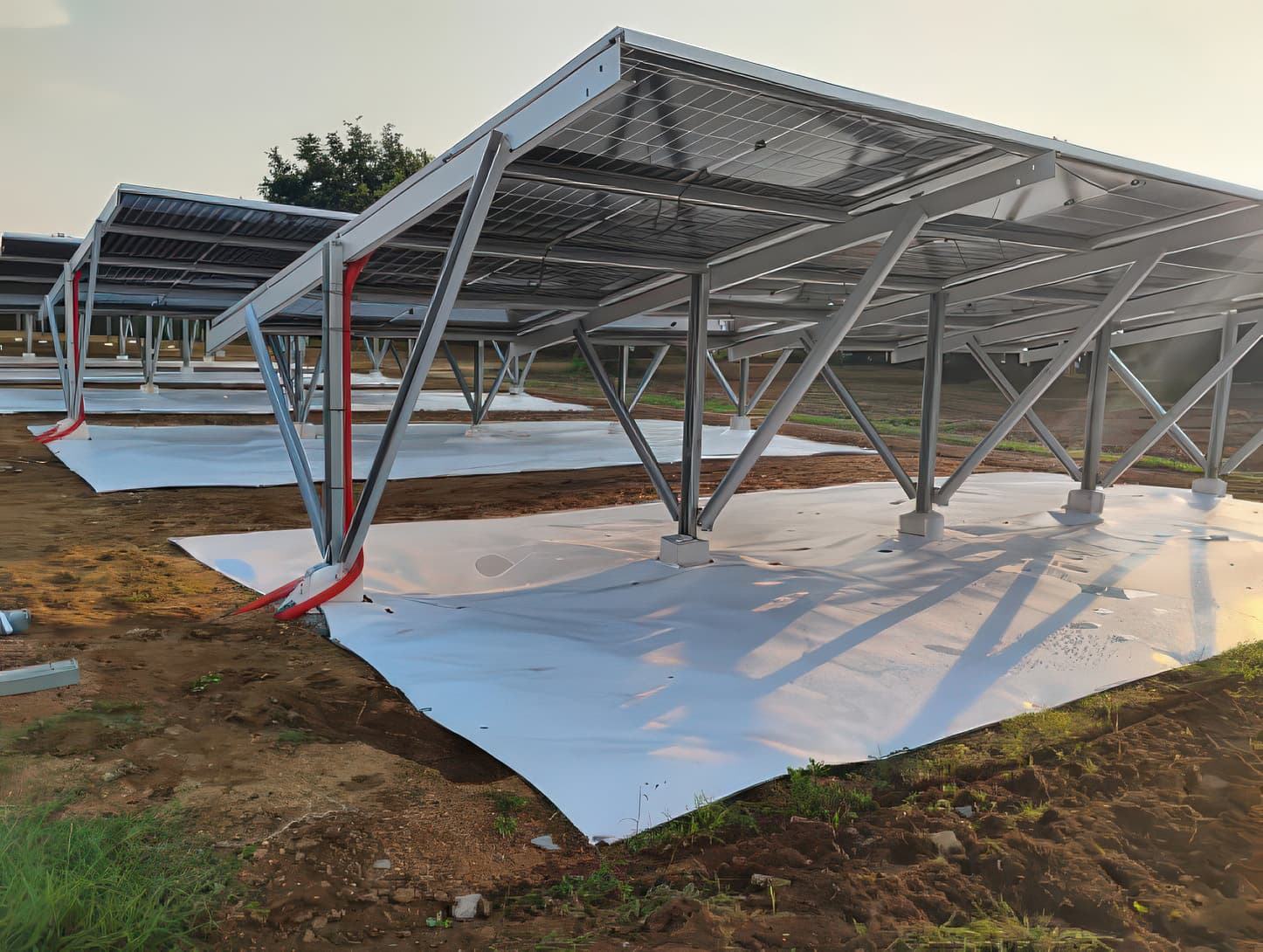
In order to boost energy yield, GEOLUX reflective sheets are installed underneath bifacial solar panels. To achieve maximum light reflection, the panels must be firmly staked to the earth so they remain as flat as possible, even in the face of less-than-ideal terrain and strong wind conditions.
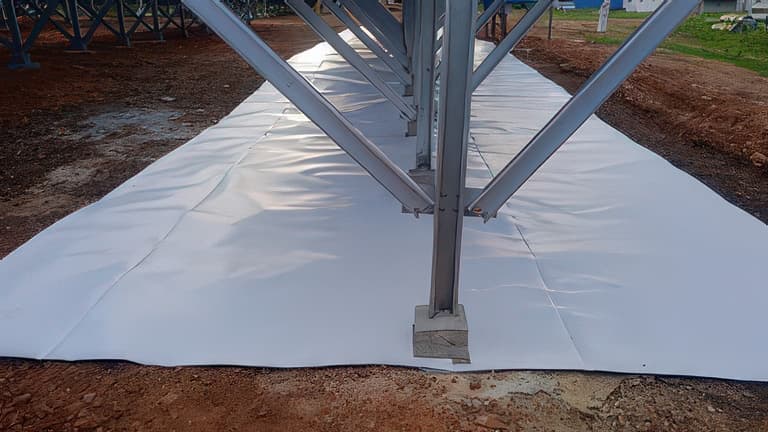
Typically this is accomplished through the use of anchors and fasteners. However, some surface areas of the solar plant were rocky and uneven, preventing pin penetration and ruling out their use. Solmax engineers and the Indian local installation team improvised, designing a solution consisting of galvanized, high-strength thermo-mechanically treated (TMT) zinc-coated steel reinforcement bars with a flat washer welded on their tops. The GEOLUX was secured to the ground and fixed into position through the manual hammering of these bars.
Weed control can prove another issue, especially on grassy areas. Additional challenges common to many solar farms include climate change and extreme-weather impacts that can undermine grid reliability and power generation. Unstable, unpredictable weather requires constant and real-time advanced monitoring and automated tracking systems in order to protect and maintain grid performance. However the high investments costs such tools require can undermine the economic viability of these projects.
Solution
A 1.00mm-thick GEOLUX reflective membrane was secured underneath the bifacial solar panels, covering that entire area. Constructed from high-quality polyethylene resins, its reflective surface contains premium-grade UV stabilizers and specialized additive packages. The UV protection provided by this white pigment is broadly favored for its long-term durability, high reflectivity, ability to maintain its albedo over many years, and its over 30-year service life.
The specialist-engineered monolithic membrane uses a proprietary blend of additives in the pigmentation. This results in a material offering the same level of UV resistance as carbon black, guarding against UV radiation and degradation, thus ensuring its long-term performance.
Through increasing the front- and rear-incident irradiance, GEOLUX is able to enhance bifacial energy yield, doing so by elevating the natural albedo of the ground to approximately 75%. Compared to uncovered grass, which may have an albedo of 20%, this results in significant energy yield improvements, as well as reductions in the levelized cost of energy (LCOE).
Additionally, since light is prevented from passing through its reflective sheets, GEOLUX serves as an impenetrable barrier, keeping weeds from growing underneath the solar panels, reducing maintenance and labor outlays, improving site safety in the process.
The comprehensive GEOLUX solution helps to offset some of the financial pressures associated with solar farm projects. This can make incorporating advanced weather monitoring and tracking technologies more feasible for owners and operators, enabling them to better protect their investment while delivering more consistent power generation.
Monitoring is in progress, but measurements taken over a period of three months reveal that for this particular project, the installation of the GEOLUX reflective panels has resulted in a consistent 5%-to-8% increase in the solar plant’s output. This should lead to reductions in structure, modules and cable costs, resulting in an overall reduction of capital expenditures.