Overview
A new bridge over the Missouri River required pavement approaches that perform under saturated soil conditions. The design-build project gave the project team an opportunity to evaluate an alternative approach to managing the water beneath the pavement section.
The original pavement design included concrete over 4 in. (102 mm) of road base aggregate, a 4 in. (102 mm) layer of drainable aggregate and prepared subgrade. The revised design incorporated MIRAFI® H2Ri to provide reinforcement, separation, and moisture-management functions within the pavement section.
Challenge
Saturated soil conditions at the bridge approaches created a need to remove water from beneath the pavement section. Without an effective means of managing subsurface moisture, water could remain within the pavement foundation and affect the performance of the roadway structure.
The Missouri Department of Transportation (MoDOT) encouraged the design-build teams to explore innovative technologies that could address the challenging site conditions. The project team therefore looked for a solution that could manage the moisture beneath the pavement while also supporting the structural requirements of the section. Working with Solmax, the geotechnical engineer evaluated MIRAFI H2Ri, a high-strength wicking geotextile as an alternative to the drainable aggregate layer.
Solution
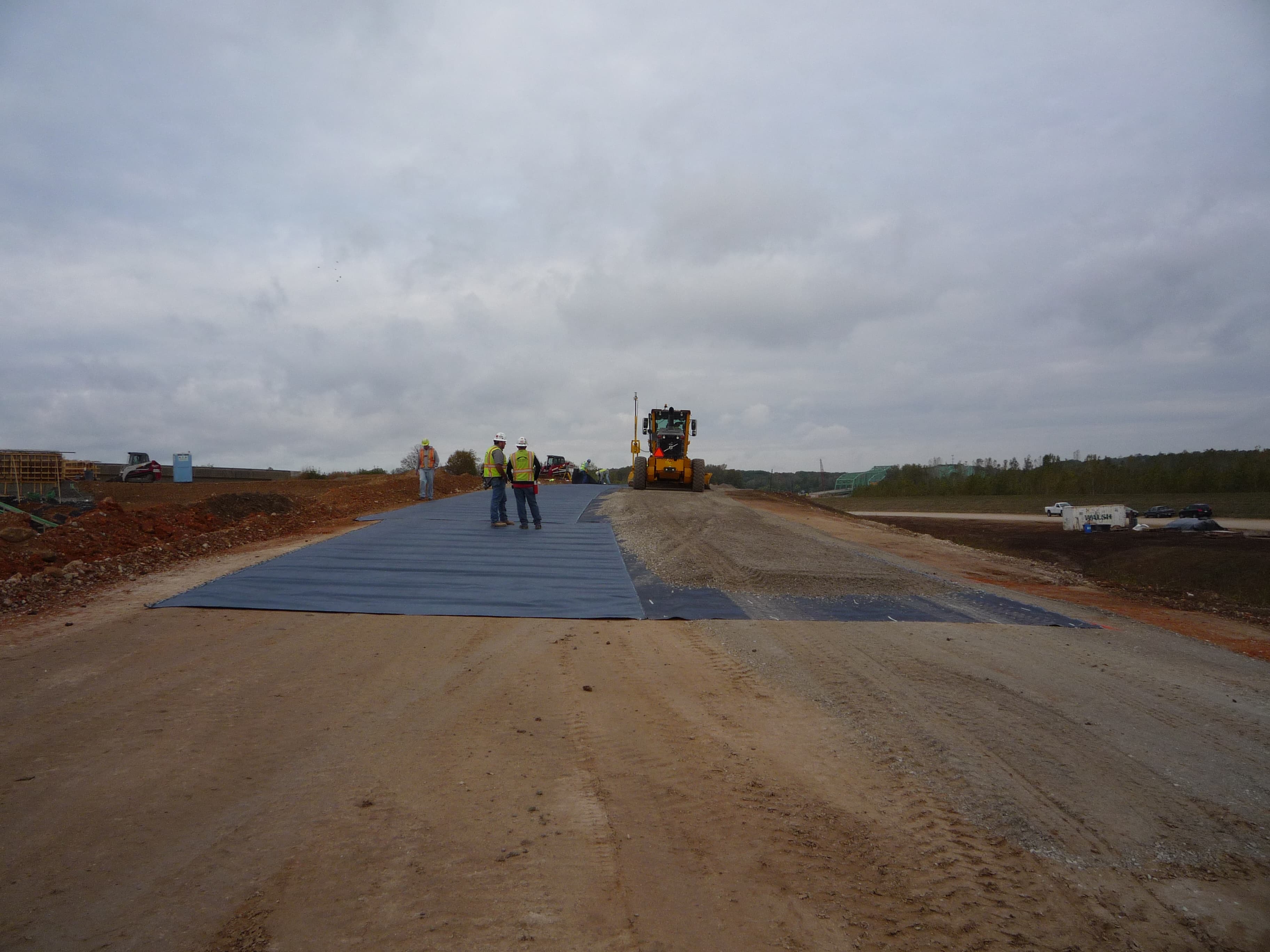
After specifications and testing, the design engineer incorporated MIRAFI H2Ri into the pavement section to replace the 4 in. (102 mm) drainable aggregate layer. The geotextile provided confinement and separation while also allowing water beneath the pavement to wick laterally toward designated discharge locations.
The revised section also allowed an overall reduction of 2 in. (51 mm) in aggregate base material, reducing aggregate requirements and associated costs. Water transported through the MIRAFI H2Ri was channeled to the site edges where it could exit the pavement section and drain effectively away from the pavement.
Before installation, Solmax and the local distributor, ASP Enterprises, coordinated a pre-construction meeting with the general contractor, MoDOT personnel, and the subcontractor responsible for installing the geotextile. The group reviewed proper overlaps, material cutting and layering, and installation practices before work began.
Initial installation covered approximately 7,200 yd2 (6,062 m2). Crews began placing the geotextile on a Thursday and completed the installation, along with placement of 6 in. (152 mm) of compacted aggregate, by the following Monday. The project received approximately 0.25 in. (6 mm) of rainfall the day after the geotextile was placed, and wicking was evident where MIRAFI H2Ri had been installed. Following the success of the original installation, the project team began plans to install an additional 82,000 yd2 (68,562.4 m2) of MIRAFI H2Ri in the following spring.