Overview
The Meadowland project in British Columbia, Canada, involved constructing a heavy-duty semi-trailer parking, storage and maneuvering area over an existing landfill. The pavement needed to support sustained static loading and repeated low-speed vehicle movements, but the underlying landfill presented highly variable and undocumented subsurface conditions. This uncertainty required a pavement structure that could distribute heavy loads over weak ground while limiting the construction risks associated with disturbing the existing landfill material.
The parking area was designed with support from Solmax and Western Tank & Lining supplied MIRAFI® RS380i high-performance woven geotextile and coordinated communication among project participants. The team incorporated the geotextile to reinforce the granular section, maintain separation from the underlying material, and establish a stable construction platform over the variable subgrade.
Challenge
The primary challenge was designing for subsurface conditions that could not be characterized consistently across the site. The composition of the legacy landfill was unknown, and the bearing capacity varied significantly between locations. In addition to supporting long-term storage and maneuvering, the pavement had to remain constructible where the underlying material could not support conventional aggregate placement and compaction.
The design team evaluated the pavement using the Giroud-Han methodology for unpaved roads. The analysis considered an 84 kN axle load, between 50,000 and 100,000 axle passes, target rut depths ranging from 1 to 1.5 in. (25 to 38 mm) and assumed subgrade strength ranging from CBR 1.5% to 3.0%. Under these assumptions, the evaluation determined that 23.6 in. (300 mm) of granular fill reinforced with MIRAFI RS380i would meet the serviceability requirements.
Conditions encountered during construction tested those assumptions. Significant rainfall softened localized portions of the site and exposed areas with extremely low bearing capacity. Although the project team did not conduct formal CBR testing, the field response in the weakest zones appeared consistent with CBR values of approximately 0.5% to 1.0%. These observations indicated that portions of the existing material were weaker than the range considered in the original evaluation.
Removing and replacing the weakest material would have required excavation into the undocumented landfill. That approach could have increased material-handling requirements, construction costs, and overall project risk. The team therefore needed to adapt the installation while maintaining sufficient support for construction equipment and the completed pavement.
Solution
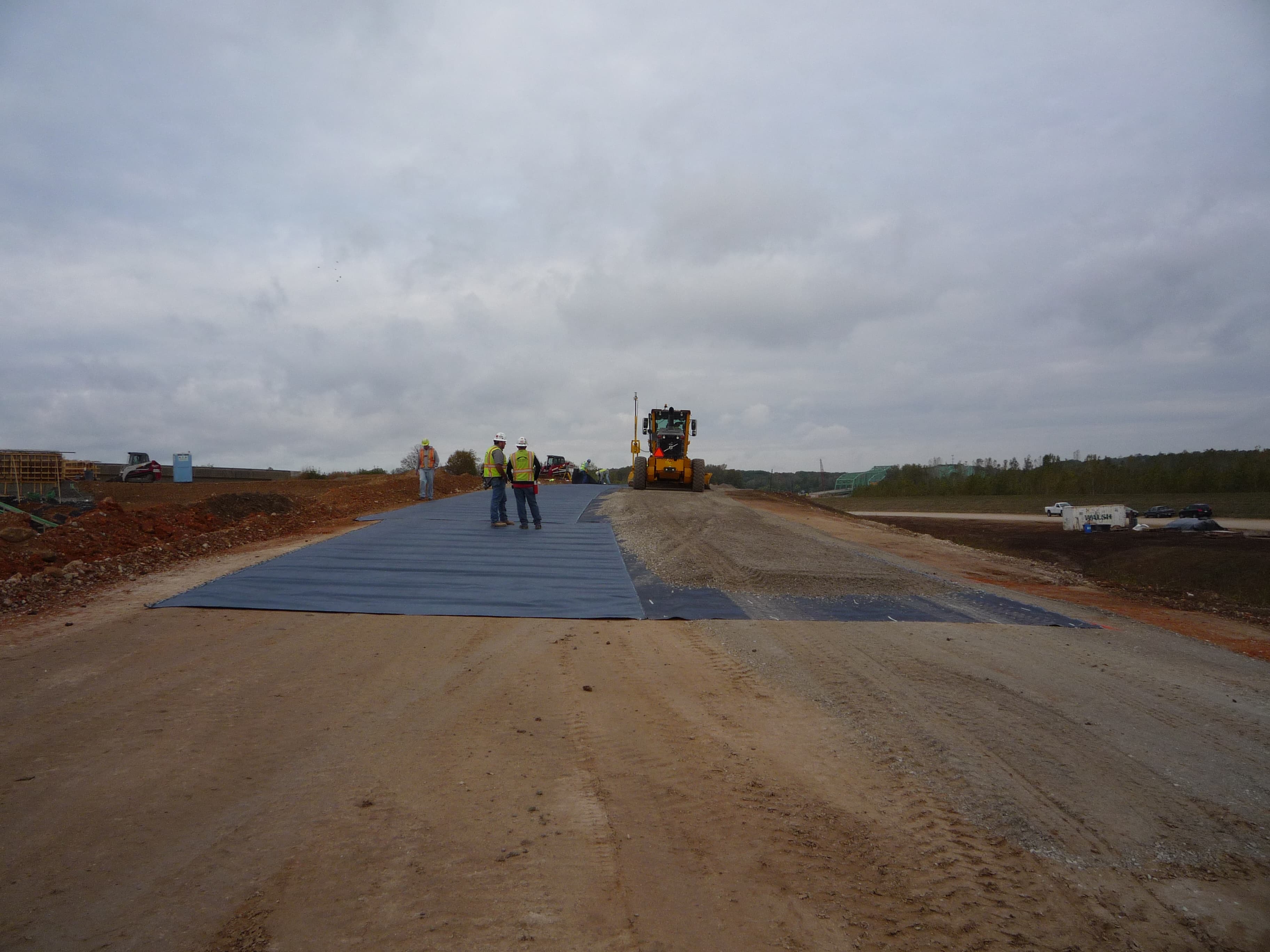
Rather than over-excavating the localized soft areas, the project team revised the construction approach around the MIRAFI RS380i reinforced section. Crews placed the geotextile directly on the prepared surface and maintained overlaps of at least 35.4 in. (600 mm) across the weak zones. They extended the material to 3.3 to 6.5 ft. (1 to 2 m) beyond these areas to provides anchorage and transition loads into the surrounding ground.
The installation also maintained at least 23.6 in. (300 mm) of granular cover over the weakest locations. Crews compacted the fill in static, non-vibratory mode to limit disturbance of the underlying landfill material. Together, these measures allowed the geotextile and aggregate layer to bridge localized soft areas while providing reinforcement, separation, and aggregate confinement.
The final pavement section exceeded the minimum evaluated thickness. Construction incorporated between 23.6 and 35.4 in. (600 and 900 mm) of granular fill over MIRAFI RS380i, followed by 3.9 in. (100 mm) of asphalt millings. This additional thickness increased load distribution through the granular section and provided greater resistance to rutting under sustained trailer loading and low-speed maneuvering.
Construction proceeded without removing or replacing the weak underlying material. The reinforced section established stable working conditions despite rainfall and localized bearing-capacity limitations, allowing aggregate placement to continue without delays associated with subgrade excavation. Although some areas appeared weaker than the conditions assumed during design, the combination of MIRAFI RS380i, increased granular thickness, and field-adjusted installation measures accommodated the variability encountered across the site. The completed section was configured to support the required trailer storage and maneuvering loads, while avoiding disturbance of the existing landfill.