Overview
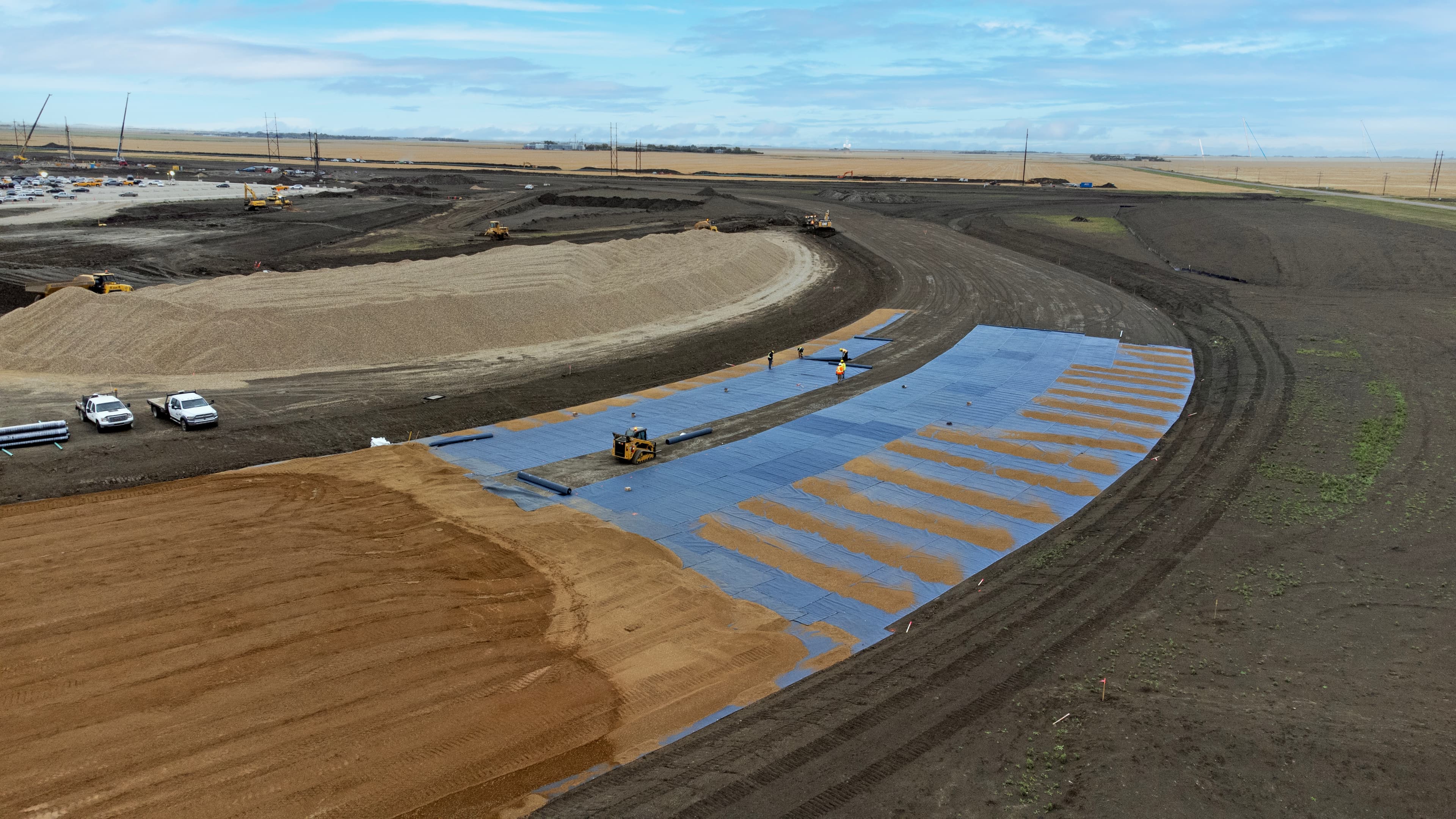
Cargill, a global leader in food and agriculture, embarked on a substantial development project in Regina, Saskatchewan, Canada, to enhance its canola production capacity. Due to growing global demand, the Regina facility, located in the Global Transportation Hub industrial park, targets an annual production capacity of approximately 1 million metric tonnes.
Challenge
The project faced challenges at the 296-acre (120-hectare) site, situated on a glaciolacustrine deposit with expansive and frost-susceptible silty clays. A comprehensive soil investigation, which included 40 drilled boreholes, revealed a high-plasticity silty clay layer. This layer’s low California Bearing Ratio (CBR) of about 1.5% and susceptibility to frost heave posed a threat to infrastructure longevity.
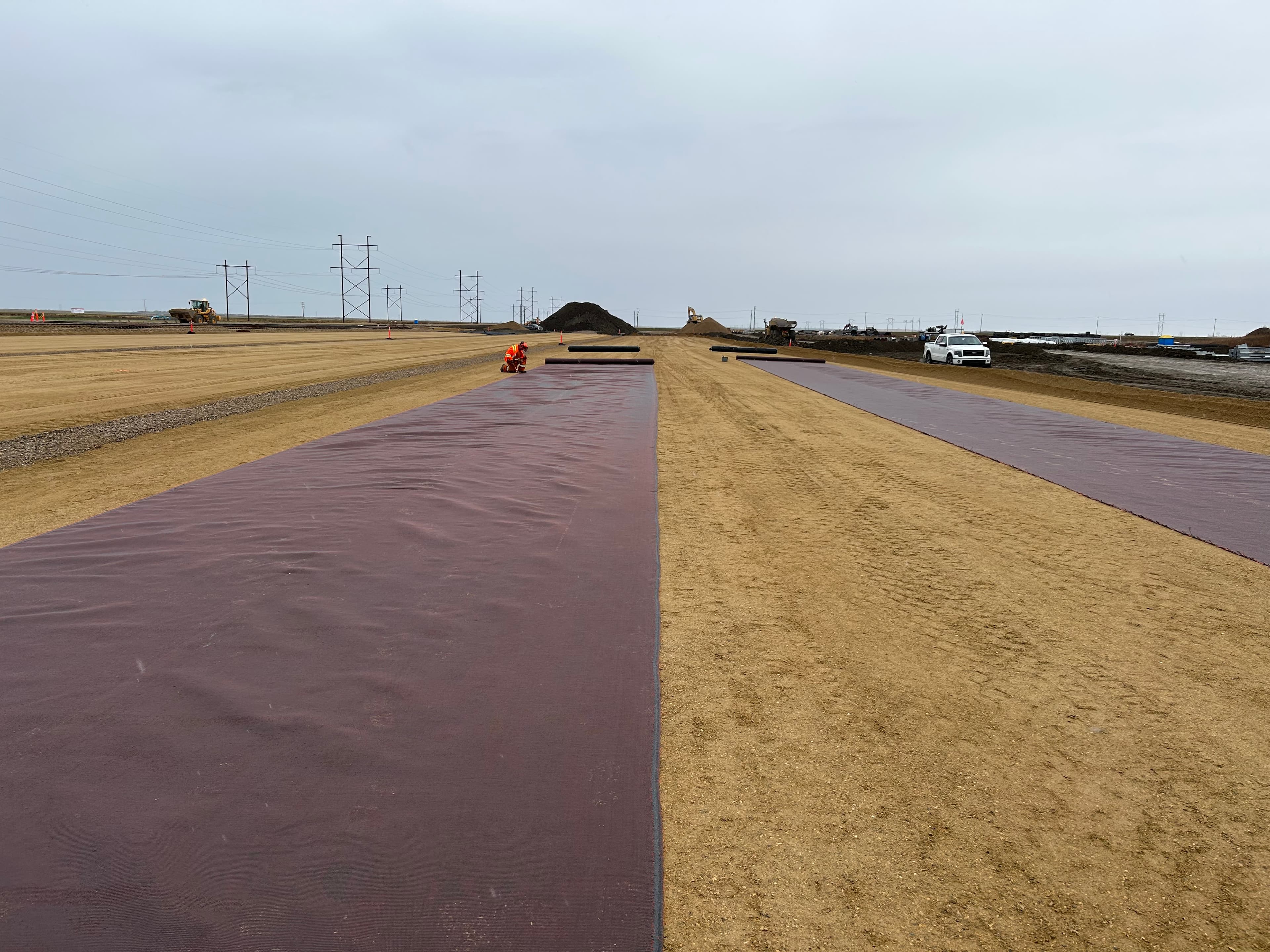
Solmax proposed innovative geosynthetic solutions for these site-specific challenges. They selected MIRAFI® H2Ri, a moisture management geosynthetic, for subgrade stabilization, addressing both expansive soil and frost heave issues.
Additionally, MIRAFI RS580i, a high modulus woven geotextile, was used for ballast reinforcement. Evaluations of the geosynthetic-stabilized rail structure, based on the Talbot equation from the AREMA Manual for Railway Engineering, showed that the structure required the same ballast thickness but with a 55% reduction in sub-ballast thickness. This adjustment led to a 20% overall cost savings compared to a non-geosynthetic rail structure.
Solution
For road construction, Solmax recommended MIRAFI H2Ri for subgrade stabilization and MIRAFI BXG120 biaxial geogrid for base layer reinforcement, following the AASHTO Guide for Design of Pavement Structures 1993. The road section with geosynthetic stabilization, incorporating MIRAFI H2Ri into the AASHTO 93 methodology, provided both mechanical and hydraulic stabilization.
The Giroud-Han method was applied for constructing the platform, integrated into the pavement structure as part of the subbase. The geosynthetic-stabilized road structure demonstrated a 20% overall cost savings compared to the original non-geosynthetic design.
This case study highlights the effectiveness of cutting-edge geosynthetic solutions in addressing challenging site conditions, including expansive and frost-susceptible soils. The use of advanced geosynthetics not only offered cost-effective alternatives to traditional construction methods but also led to significant savings for Cargill.
The integration of design methodologies such as the Talbot equation, AASHTO 93, and the Giroud-Han method underscored the efficiency and sustainability of these innovative solutions. The case study underscores the growing importance and transformative impact of geosynthetic technology in civil and environmental engineering projects.