Crowne Point Country Club Case Study
Crowne Point Country Club rehabilitated a deteriorated Vermont access road with MIRAFI H2Ri, using active moisture management to address saturated soils, frost-related distress and subgrade instability.

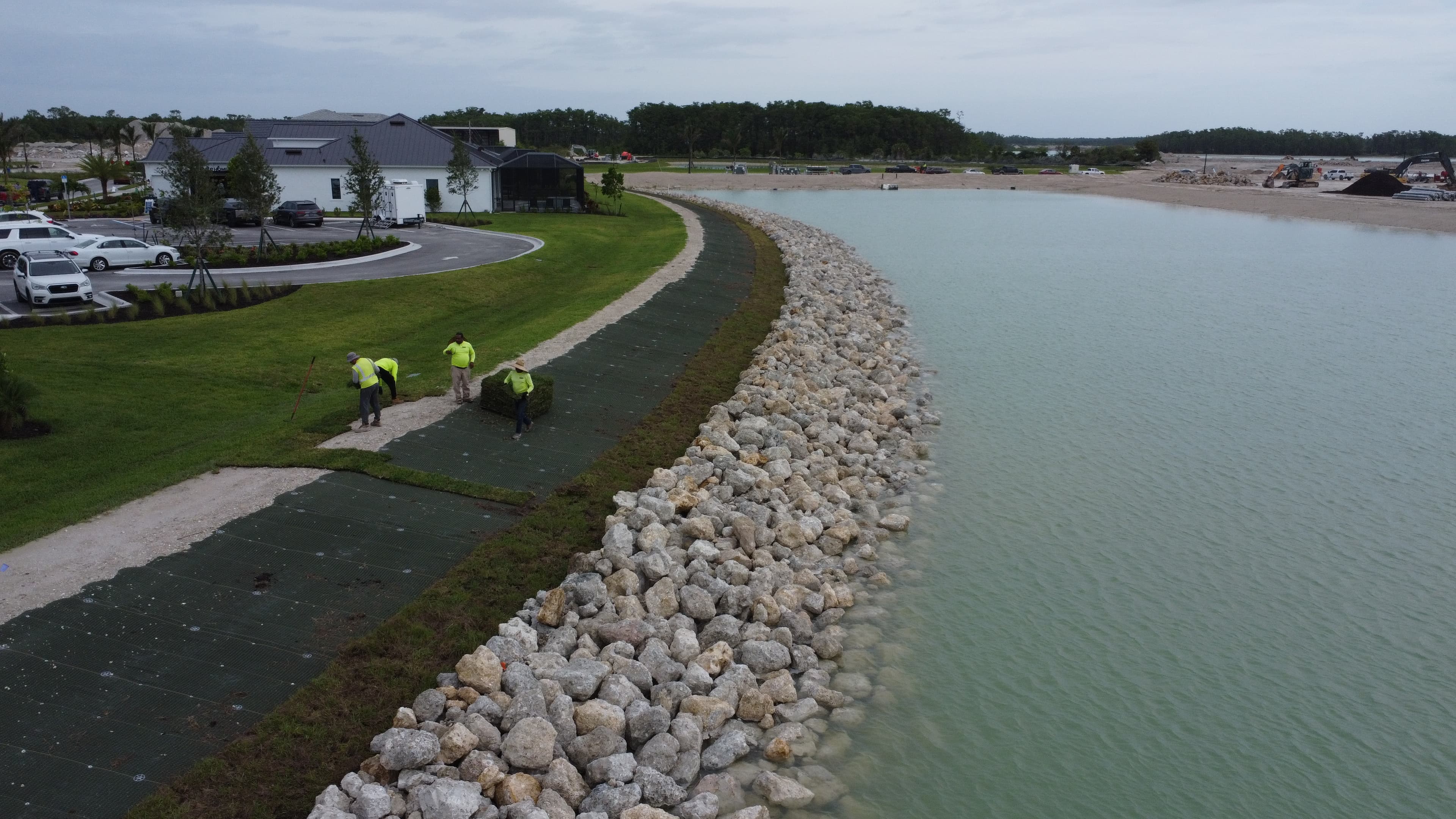
Sod installation taking place after PROPEX Armormax installation completion.
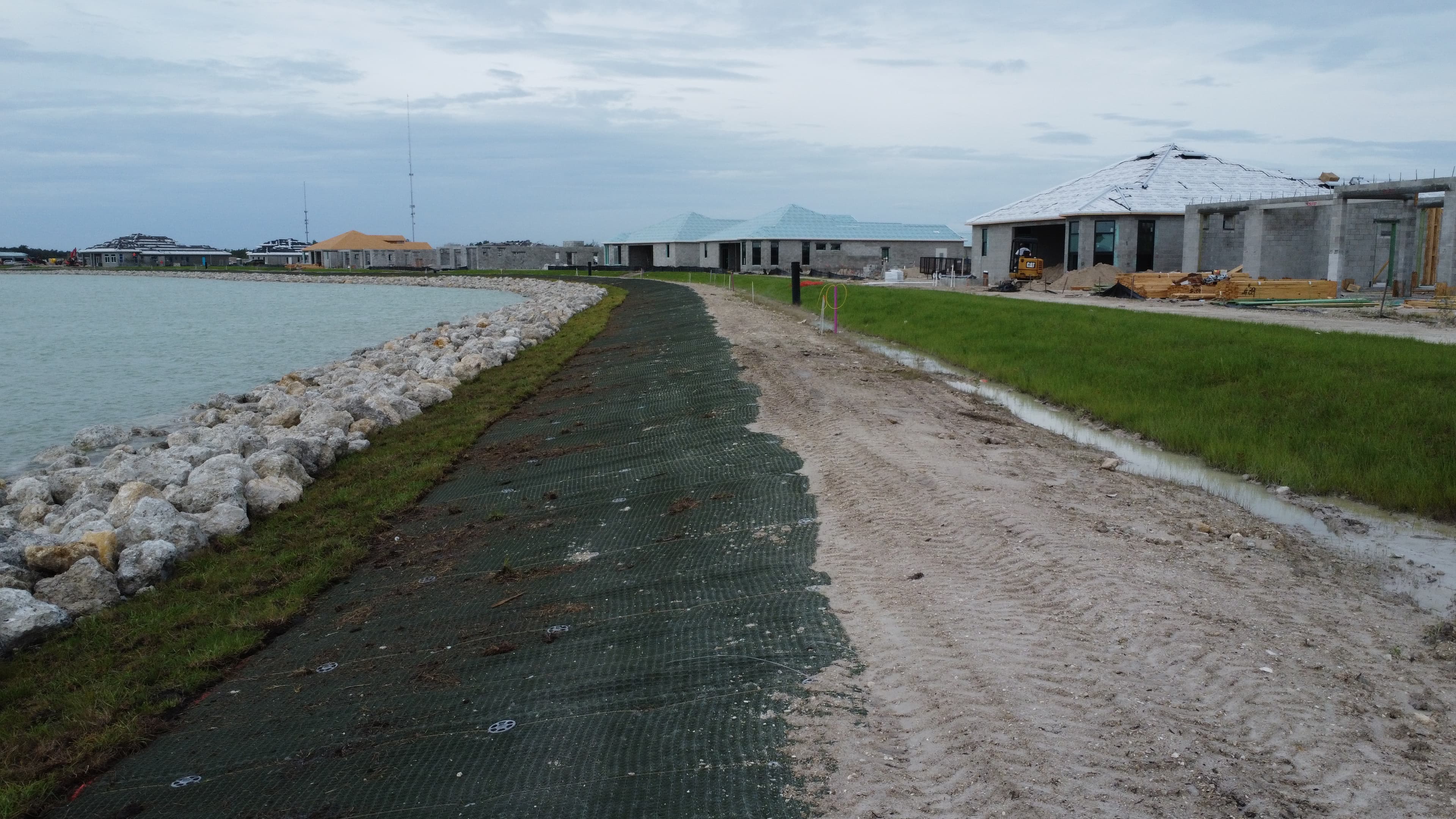
The PROPEX Armormax, sod, and riprap layout during final stages of project.
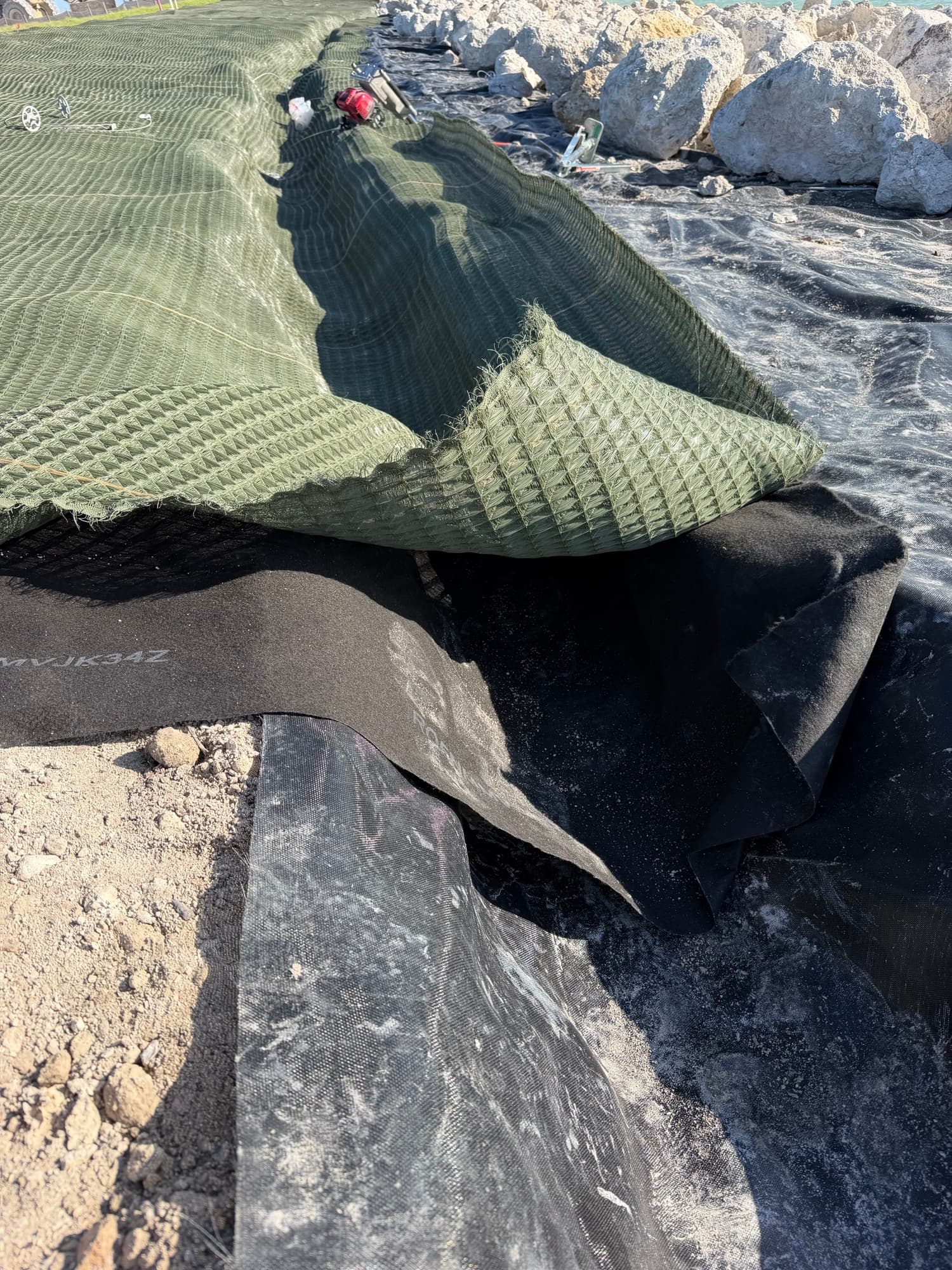
Installed PROPEX Armormax, overlapped with MIRAFI FW403, prepped for distribution of riprap from nearby mine.
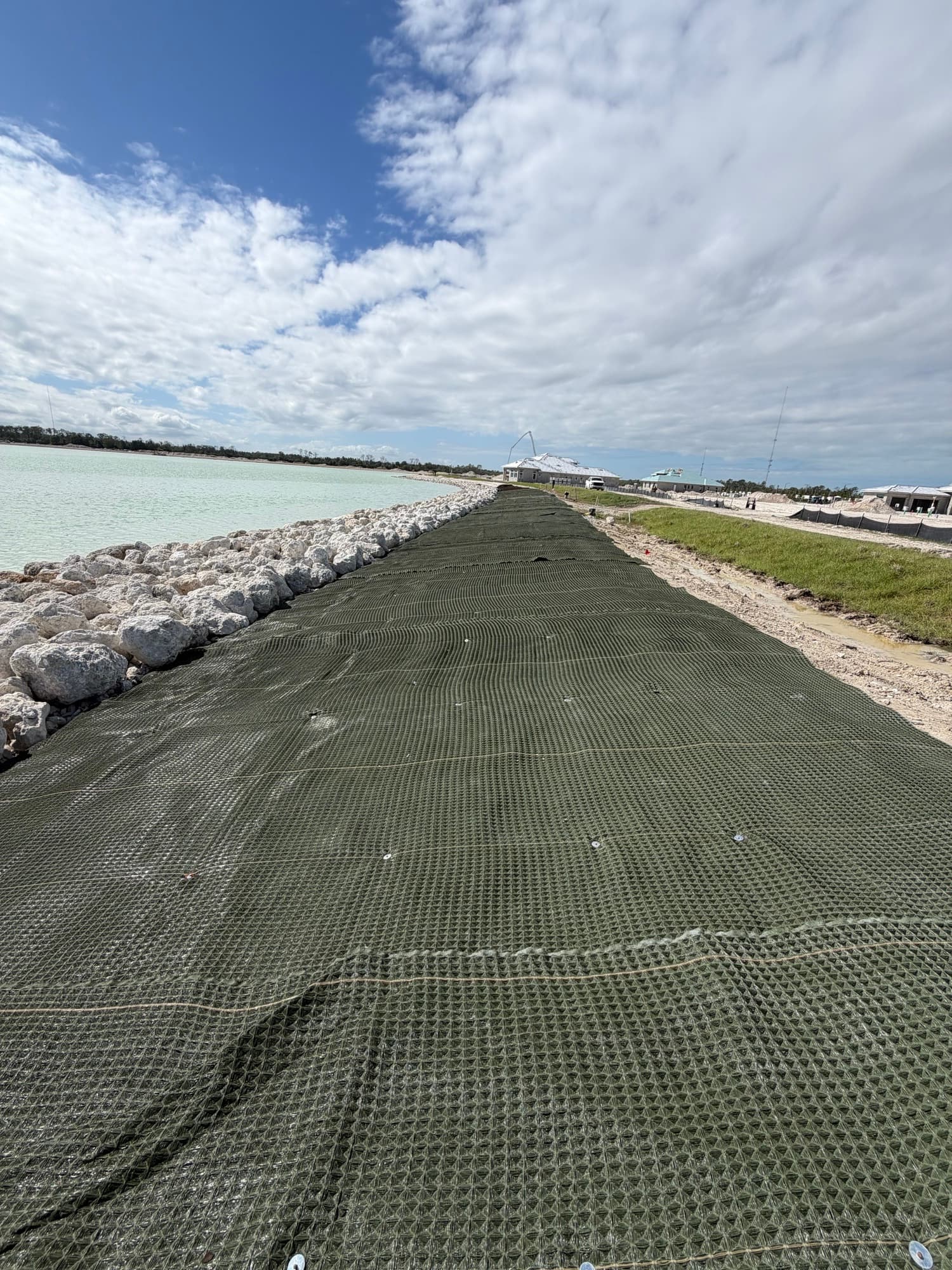
Newly installed PROPEX Armormax, secured with anchors.
Crowne Point Country Club Case Study
Crowne Point Country Club rehabilitated a deteriorated Vermont access road with MIRAFI H2Ri, using active moisture management to address saturated soils, frost-related distress and subgrade instability.

GSE HD geomembrane lined salt ponds ensure long-term brine containment
GSE® HD geomembrane lined over 3.4 million m² of evaporation ponds to prevent brine seepage under extreme heat and UV exposure. This continuous barrier eliminated salt discharge and protected the surrounding environment.
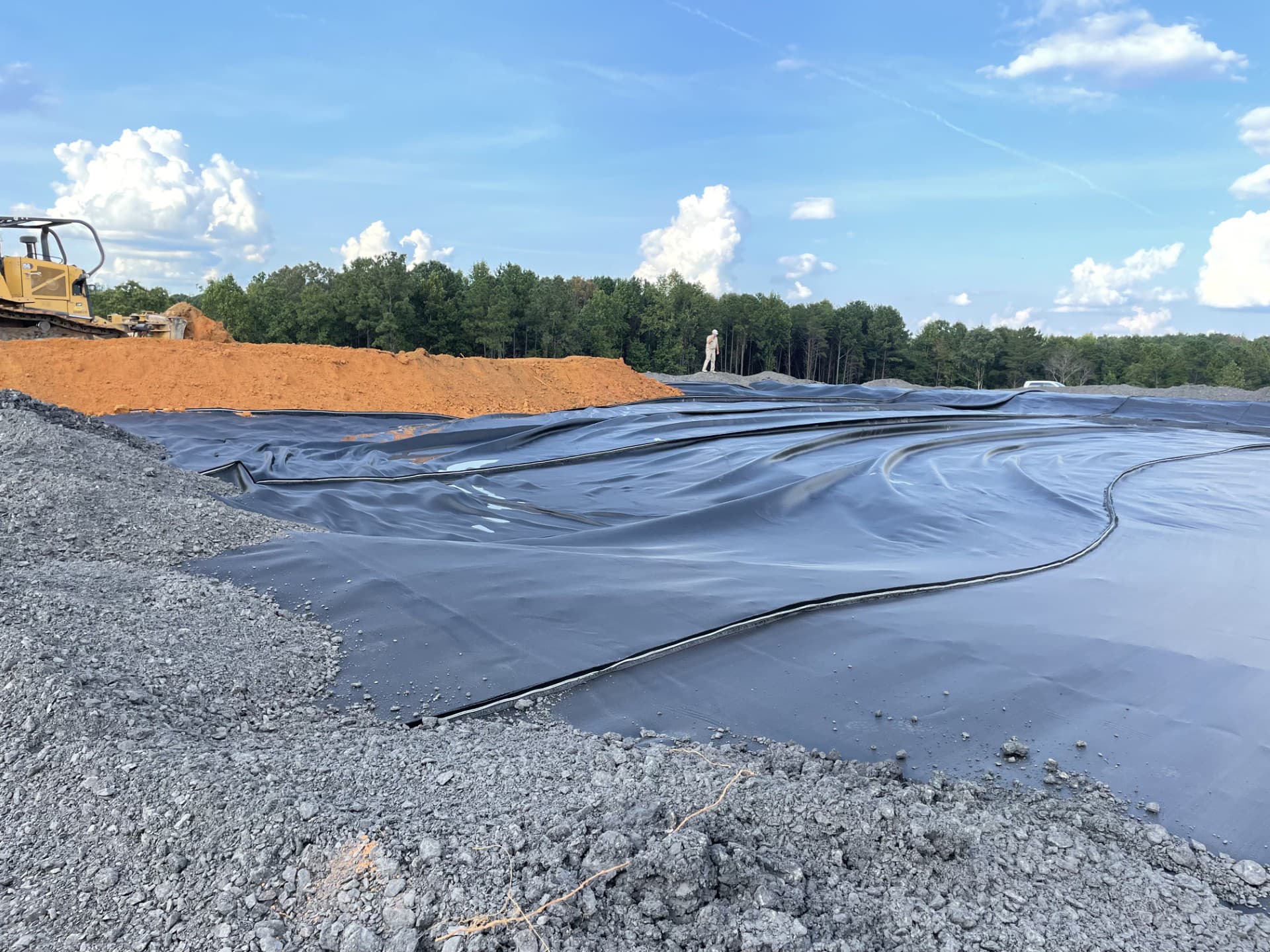
Jefferson Coal Slurry Impoundment Closure
In Jefferson County, Alabama, MIRAFI® CR440 was used with CCR fill to create a reinforced construction platform over soft fine coal refuse, supporting safe equipment access and efficient coal slurry impoundment closure.
Vivid Shores is a new residential community in Bonita Springs, Florida, located along the banks of a retired lime rock mine that formed a 170-acre (0.68 km2) lake measuring more than half a mile wide (0.80 km). The size of the lake created substantial exposure to wind-generated waves, resulting in an extreme erosion risk along the shoreline and adjacent residential lots. The project required a lake-bank stabilization system capable of addressing wave-induced erosion at the water’s edge while protecting higher portions of the slope and supporting established vegetation.
The project team, which included the developer, civil and coastal engineers, and a materials distributor, evaluated stabilization options that could respond to the site’s erosion conditions while remaining compatible with the surrounding aesthetics. The final design combined locally available stone with three geosynthetic products: PROPEX® Armormax®, MIRAFI® FW403, and MIRAFI 140N. Each component addressed a different elevation and erosion mechanism, along the lake bank.
The primary engineering challenge was controlling erosion across a shoreline exposed to wave energy generated by wind fetch over a large body of water. Due to the lake extending more than half a mile (0.80 km) across, wind-driven waves could act directly on the lake banks, creating the potential for soil loss along the shoreline and affecting adjacent residential lots. The secondary challenge was addressing erosion caused by overland stormwater runoff. The stabilization system therefore needed to address different hydraulic and erosion conditions from below the control water elevation through the upper vegetated portions of the bank.
At the water’s edge, the design required a system capable of dissipating wave energy while maintaining separation between the underlying soil and overlying rock. Without an appropriate separation layer, fine soil could migrate into voids within the riprap, potentially contributing to progressive soil loss. At the same time, the system needed to permit groundwater to move freely into and out of the lake rather than creating an impermeable barrier.
Above the rock-protected zone, the design needed to stabilize areas where vegetation would provide surface cover, but where additional erosion resistance and protection against potential soil loss were still required. The selected system also needed to integrate with the residential development’s desired appearance.
A sheet pile wall along the lake bank had originally been proposed as an alternative. During the evaluation process, that option was determined to be substantially more costly and carried a risk of failure during an extreme storm event. The project team instead selected a system that combined rock armoring, vegetation reinforcement, and geotextile separation and protection.
The final design divided the lake bank into functional stabilization zones based on elevation and exposure to erosion. Along water’s edge, large stones obtained from the former mine were placed from just below control water elevation to slightly above it. This rock layer was intended to dissipate wave energy caused by wind fetch across the lake.
MIRAFI FW403 was installed beneath riprap to provide separation between the underlying fine soil and rock layer. This separation function was intended to prevent fine soil from migrating into the rock bed while still allowing groundwater to flow freely into and out of the lake. In this configuration, the geotextile supported performance of the riprap system without restricting groundwater movement.
At elevations above the rock armoring, PROPEX Armormax was selected to reinforce the sod-established vegetation. This extended erosion protection beyond the wave-dissipation zone and addressed higher portions of the lake bank where vegetated stabilization was required. MIRAFI 140N was installed beneath the PROPEX Armormax reinforced areas to provide additional protection against soil loss. Together, these components created a transition from rock armoring at the water’s edge to reinforced vegetation higher on the bank.
The selected approach addressed the site’s erosion conditions through complementary functions rather than relying on a single stabilization method. Rock provided direct resistance to wave action near control water elevation, MIRAFI FW403 maintained separation beneath the riprap while permitting groundwater flow, PROPEX Armormax reinforced the vegetated upper bank, and MIRAFI 140N provided an additional layer of protection against soil loss beneath those reinforced areas. Although installation remains ongoing because of the project’s scale, completed sections are performing as designed, demonstrating the effectiveness of the integrated approach in addressing the site’s defined erosion and constructability requirements.