Overview
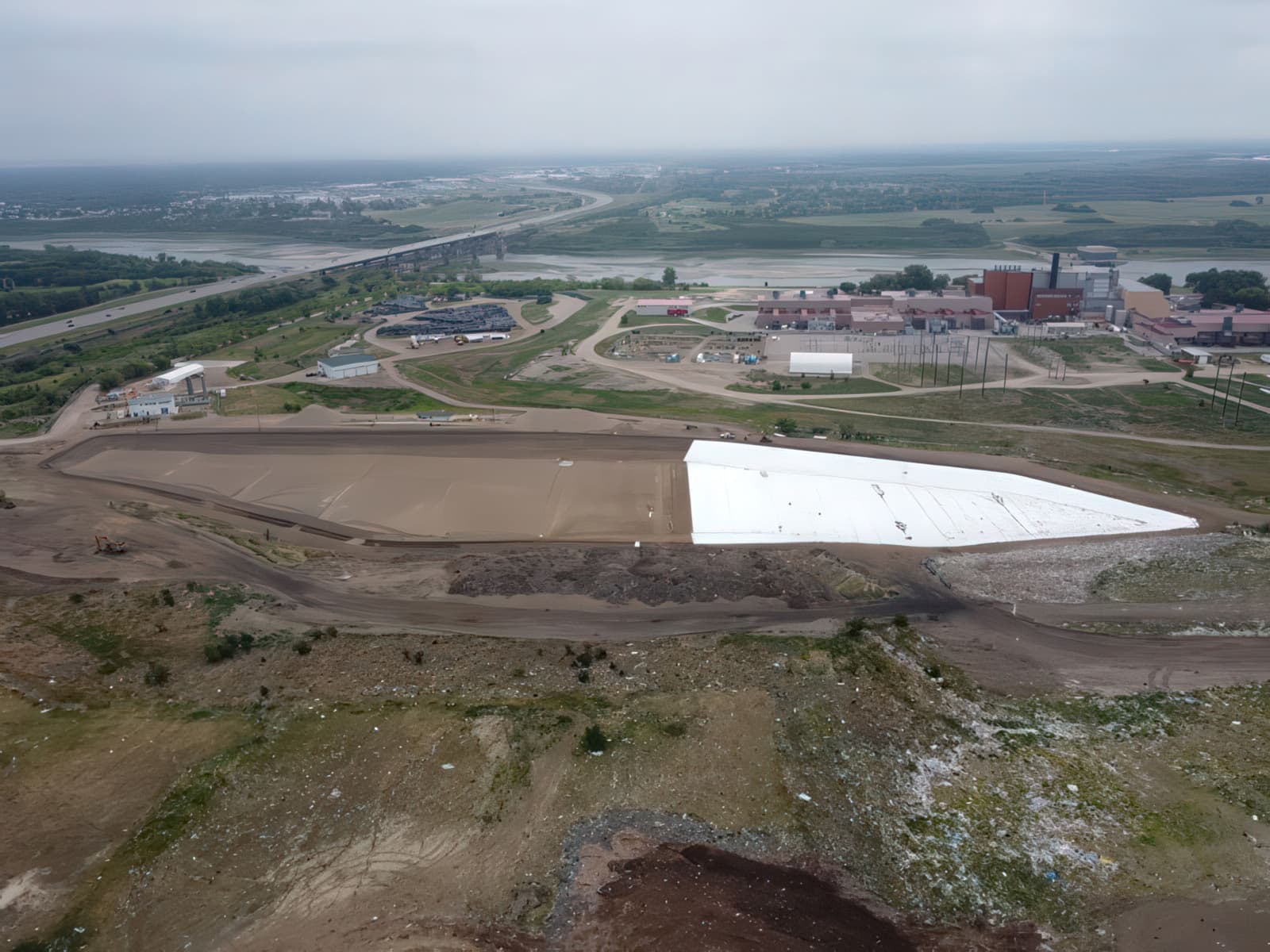
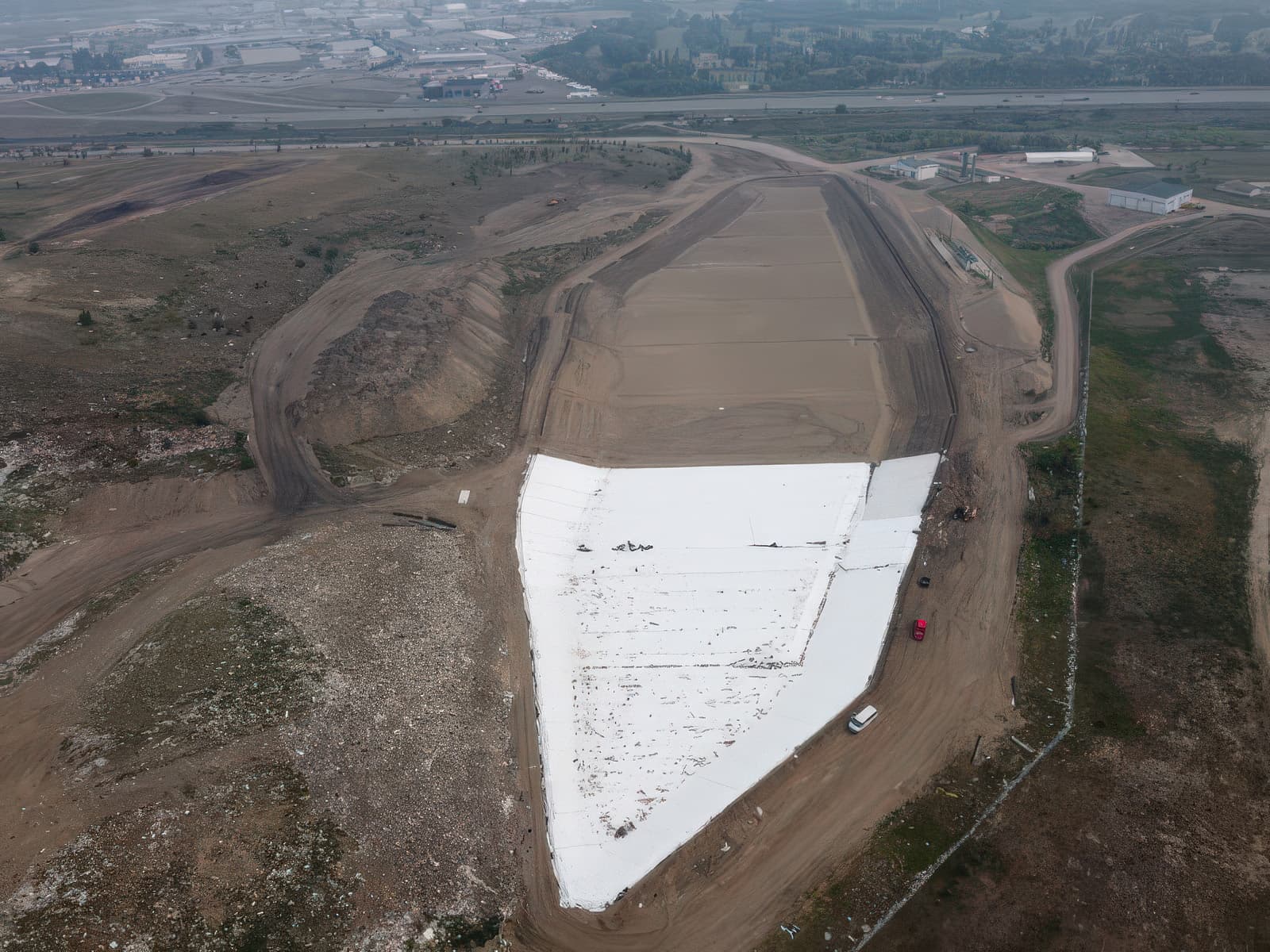
The City of Saskatoon’s East Lateral Liner Expansion (ELLE) Project represents the final planned expansion of its municipal solid waste landfill facility. The new cell measures approximately 1,444 ft (440 m) in length by 328 ft (100 m) in width, with an average depth of 16 ft (5 m), providing just over 247,200,000 ft3 (7,000,000 m3) of remaining airspace. This capacity extends the operational life of the facility, with closure currently projected around the year 2070.
In addition to cell development, the project included expansion of the existing landfill gas infrastructure, resulting in a fully looped system connected to the landfill gas plant to support long-term gas management and operational efficiency. Engineering was led by AECOM out of Saskatoon, Saskatchewan, with geosynthetic installation carried out by GE Environmental, also based locally in Saskatoon. Solmax supplied the complete geosynthetic liner system, with installation completed by the end of July 2025.
Challenge
The ELLE project presented a series of interconnected site challenges that demanded careful planning and close collaboration between the engineering, construction, and regulatory teams. A higher-than-anticipated groundwater table was identified early as a primary concern. Combined with areas of historical buried waste and residual hydrocarbons within the proposed cell footprint, remediation activities required careful sequencing to address contaminated materials while limiting disturbance to the groundwater table and maintaining suitable subgrade conditions for liner installation.
Construction of the new cell adjacent to an existing historical waste mound along the west slope introduced further complexity. Liner trenches and engineered clay barriers were incorporated to manage the interface between new and existing waste and to minimize the potential for leachate breakout during excavation. Throughout the project, the team worked closely with Saskatchewan’s Ministry of Environment to remediate historical contamination to the extent practicable while maintaining regulatory compliance and constructability.
Beyond the subsurface challenges, the construction team contended with a demanding set of on-site and environmental conditions. High winds, periods of rain, and working near an active landfill increased site congestion and required ongoing coordination. Wildfire smoke from neighboring provinces also affected visibility and air quality at various points during construction season, demanding heightened safety awareness and flexible scheduling. Saskatchewan’s short construction season added further pressure, making efficient, uninterrupted liner installation critical to the project’s overall success.
Solution
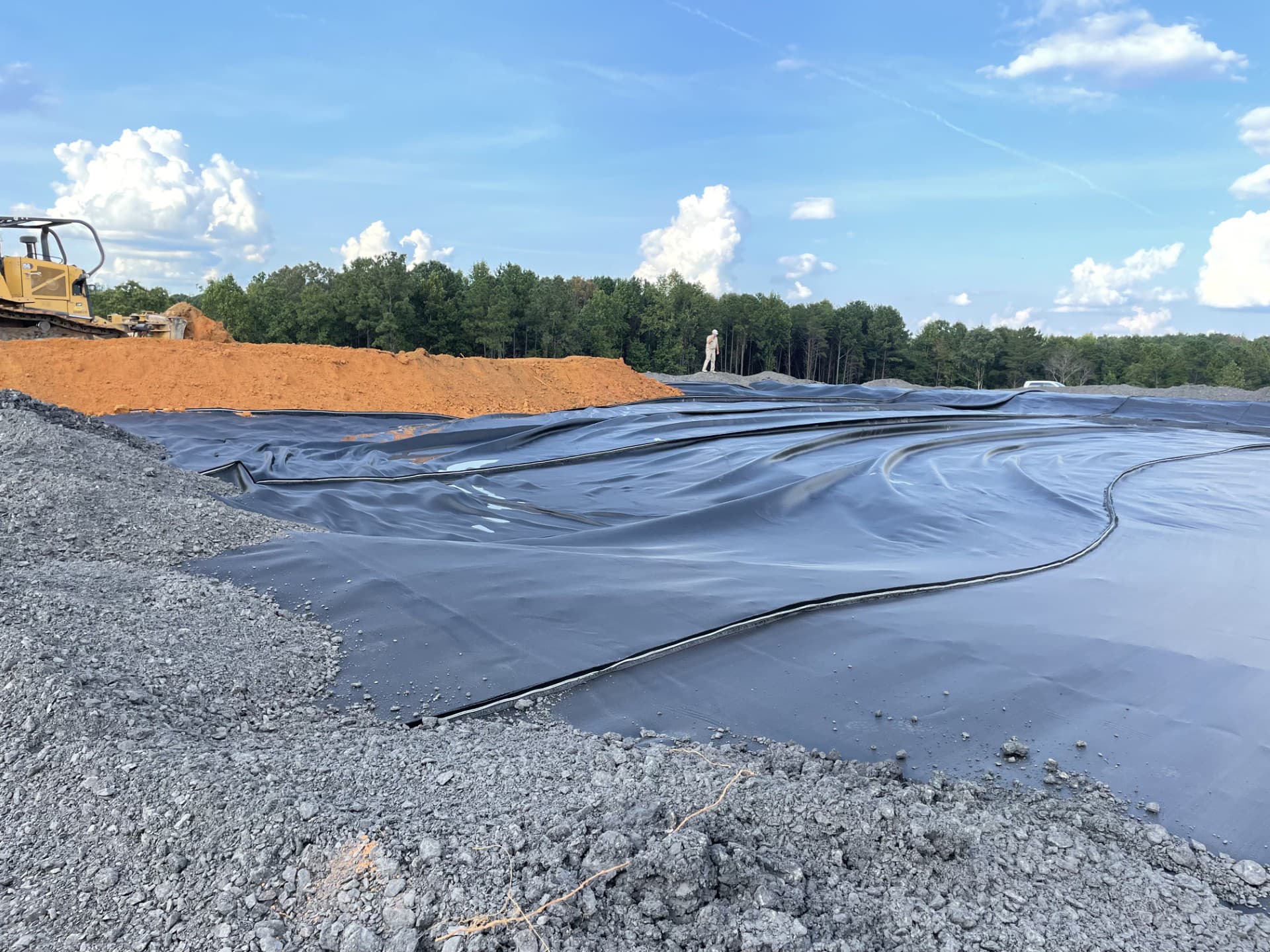
To address the site’s containment requirements, interface complexity, and demanding construction conditions, AECOM specified a composite liner system comprised of three geosynthetic technologies. As the leader in geosynthetic solutions, Solmax was able to provide all needed materials: BENTOLINER® Geosynthetic Clay Liner (GCL), GSE® white reflective HD geomembrane, and FABRINET® Drainage Geocomposite. The system was designed as a layered assembly to support groundwater protection, interface stability, and leachate management while accommodating the site’s geometry and existing waste interfaces. In total, approximately 958,000 ft2 (89,000 m2) of geosynthetics were installed across the cell.
BENTOLINER GCL was installed across approximately 409,000 ft2 (38,000 m2) of the cell. As a fabric-encased geosynthetic clay liner, BENTOLINER provides a low-permeability hydraulic barrier well suited to the subgrade variability present at the site, offering reliable performance, even where subsurface conditions are uneven or subject to differential movement.
Above the GCL, white reflective GSE HD geomembrane at 60 mil (1.5 mm) was specified in two configurations to address the differing demands of the cell floor and slopes. Approximately 269,000 ft2 (25,000 m2) of smooth, white GSE HD was installed on the floor to support temperature management within the liner system, providing a practical benefit in a climate with significant seasonal temperature variation. Approximately 140,000 ft2 (13,000 m2) of double-sided, textured white GSE HD was used on the slopes to provide the additional interface friction required by the steeper geometry.
The drainage layer consisted of 140,000 ft2 (13,000 m2) of FABRINET BP 300-8-8 geocomposite, featuring a 300 mil (7.6 mm) drainage core with double-sided 8 oz/yd nonwoven geotextiles. This configuration provided the flow capacity needed to manage leachate effectively across both the floor and slope sections of the cell.
A comprehensive planning phase that began months before construction underpinned the efficiency of the installation. Early product selection and proactive procurement ensured all geosynthetic materials were available on time and aligned with product specifications- an important factor in mitigating supply chain risk ahead of a season-constrained schedule. Coordination with GE Environmental, a certified local installer, supported responsive communication between all parties and allowed design changes that arose during construction to be incorporated efficiently without compromising quality or progress.
Result
The completed liner system met the containment, stability, and regulatory requirements of the ELLE project while supporting an efficient construction process under challenging conditions. Solmax products allowed liner installation to progress effectively into colder weather, providing critical schedule flexibility during a complex excavation and remediation process- an important advantage given Saskatchewan’s limited construction window.
The project was delivered on time and on budget. The combination of thorough early planning, a locally coordinated supply and installation team, and an adaptable on-site execution strategy enabled the team to navigate environmental constraints and operational complexity without major disruption. The result is a liner system that meets the City of Saskatoon’s regulatory, operational, and long-term performance objectives, supporting the facility’s continued operation to its projected closure around 2070.