Overview
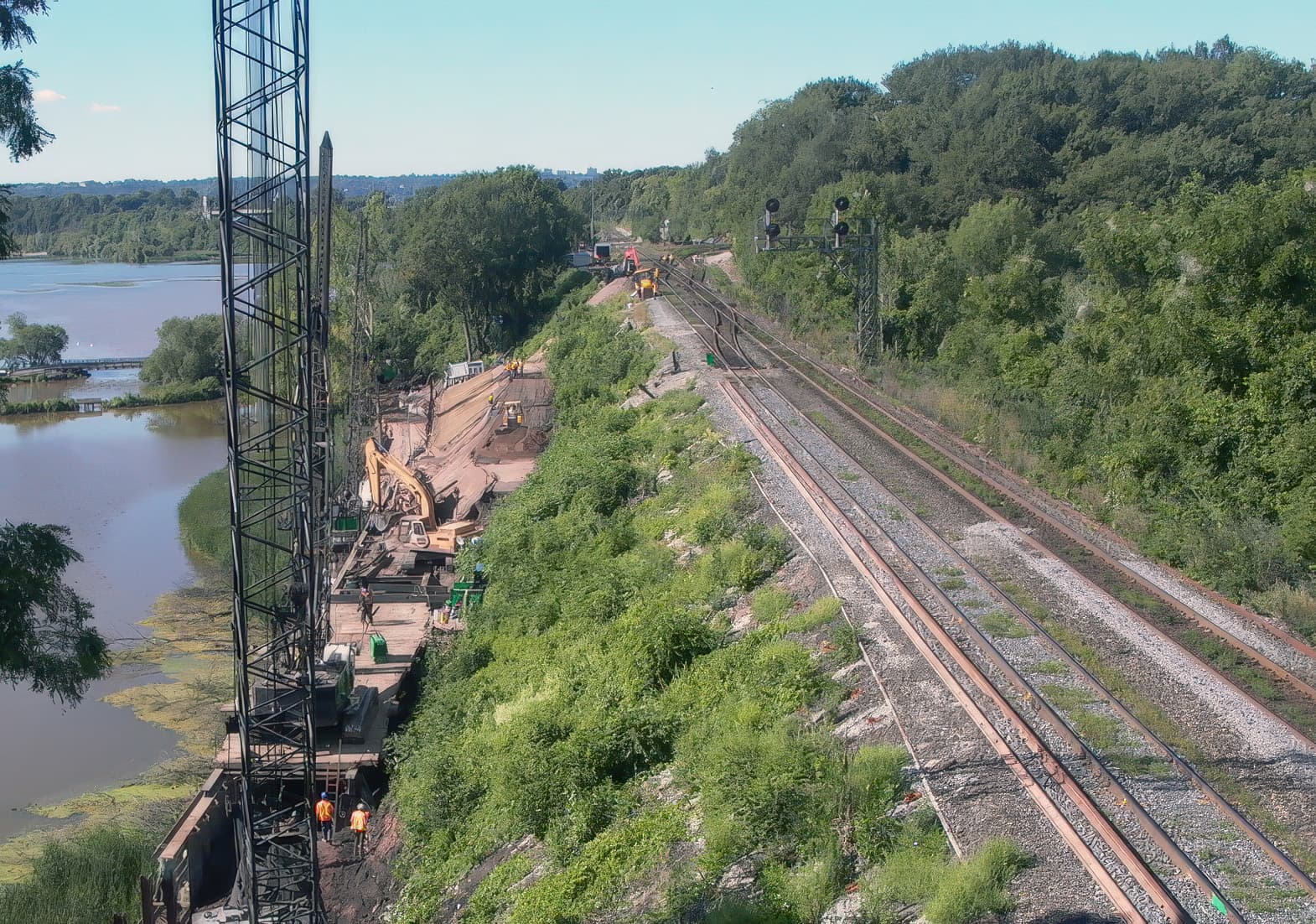
GO Transit, the Greater Toronto Area’s commuter rail/bus system operator is currently undergoing a dramatic expansion in service. Part of this expansion is the improvement in the rail service between Hamilton, Ontario and Toronto, some 50 km to the East. Additional track has been required in order to meet this growing demand. In the area of East Hamilton, just South of the intersection of Highways 403 and 6, an existing railway embankment supports CN Rail’s twin track as it passes adjacent to Sunfish Pond. This non-engineered rail embankment was originally constructed around 1900, and currently supports the main CN Rail line running from Halifax to Chicago, as well as GO Transit traffic and other passenger and freight services.
Challenge
To meet the increasing traffic demand a third track had to be constructed along the embankment alignment and this required the embankment crest to be widened. Sunfish Pond is part of an environmentally sensitive watershed in the area that is managed by the local botanical gardens authority. Consequently, any widening of the existing rail embankment was not allowed to impinge on the pond. Thus, construction of a conventional, widened, 1V:2H embankment slope would have had the slope toe encroaching well into the pond, and thus was not permitted. Therefore, an alternative solution which met both the track alignment requirements and the environmental requirements of Sunfish Pond had to be found.
Solution
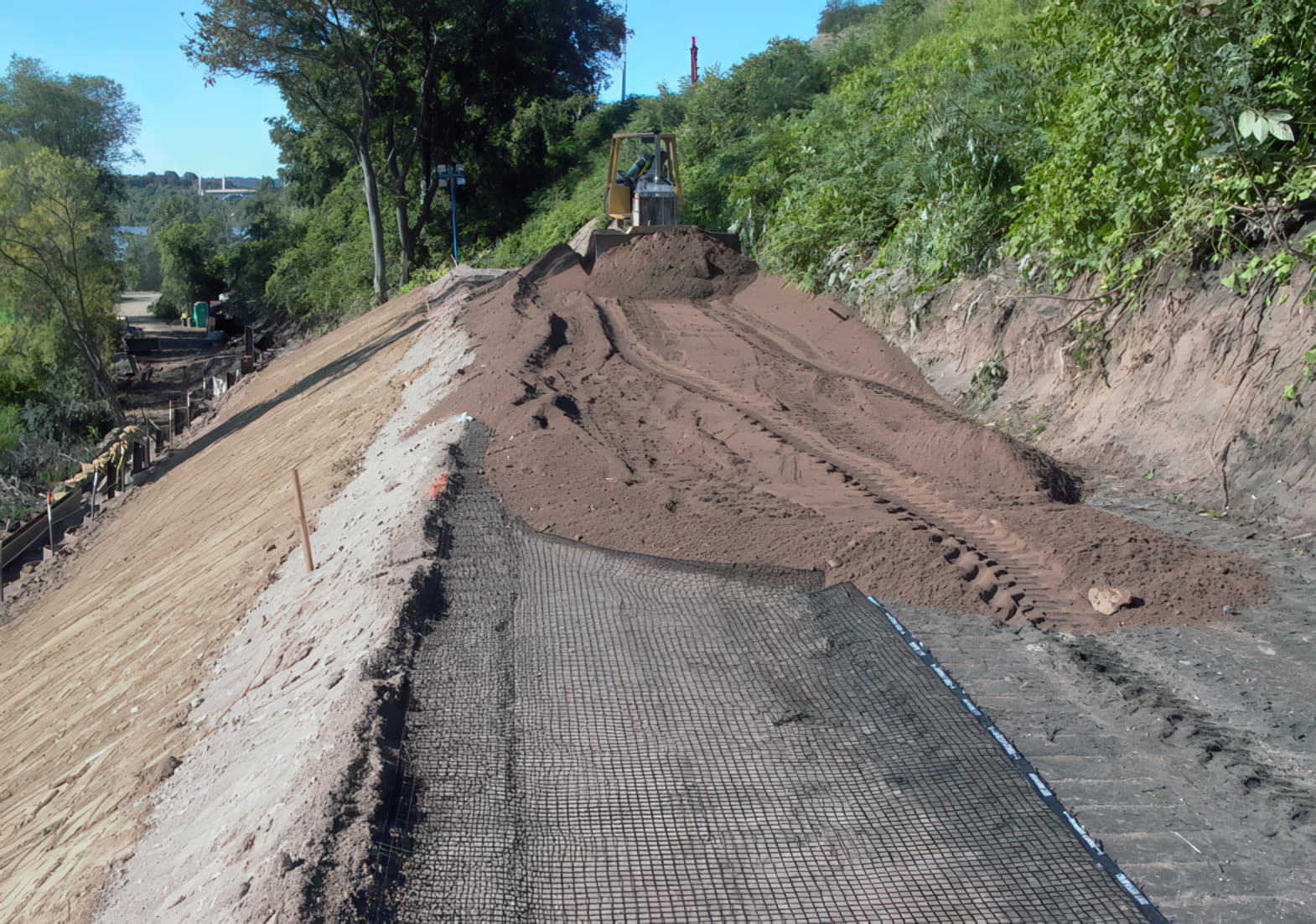
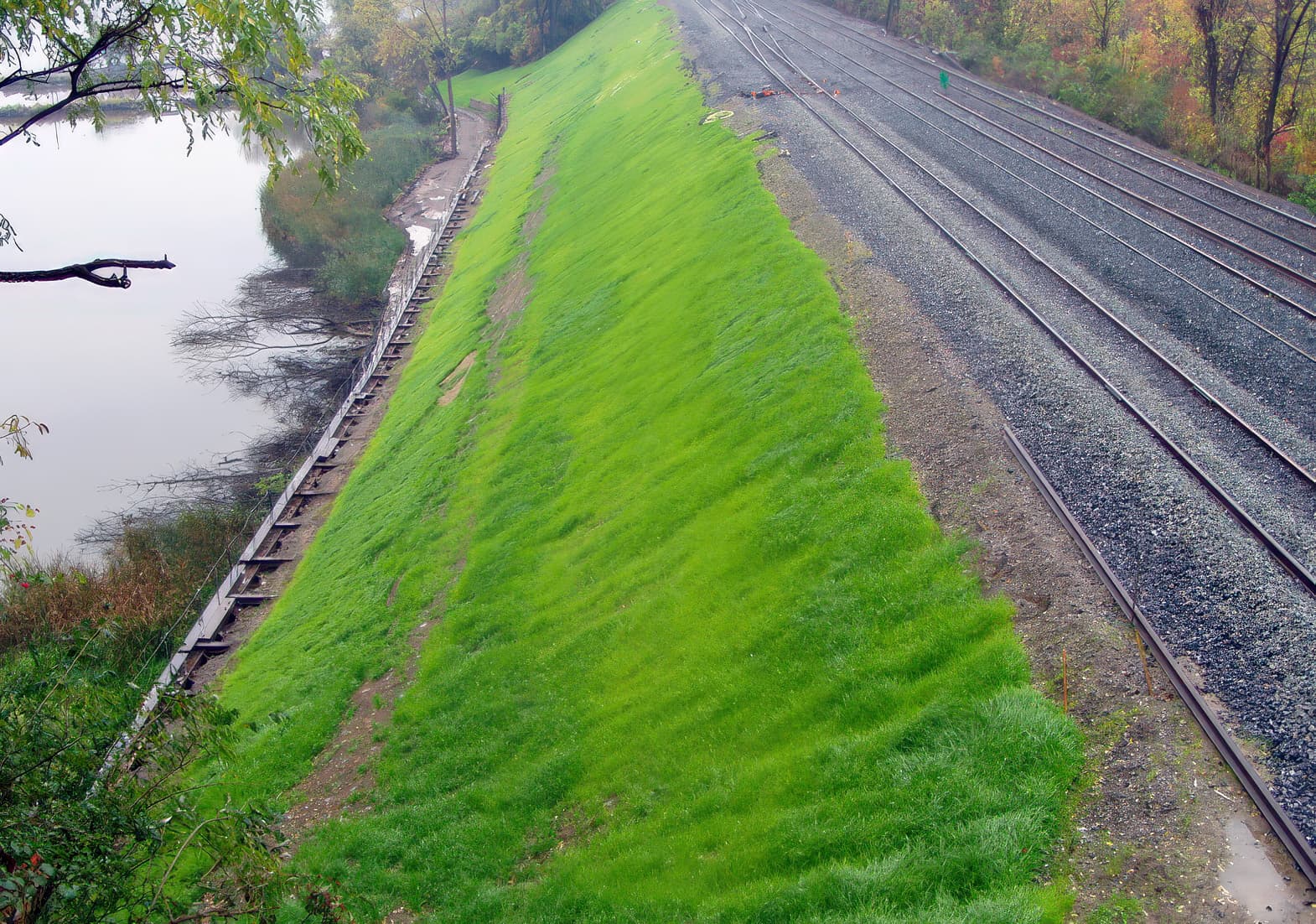
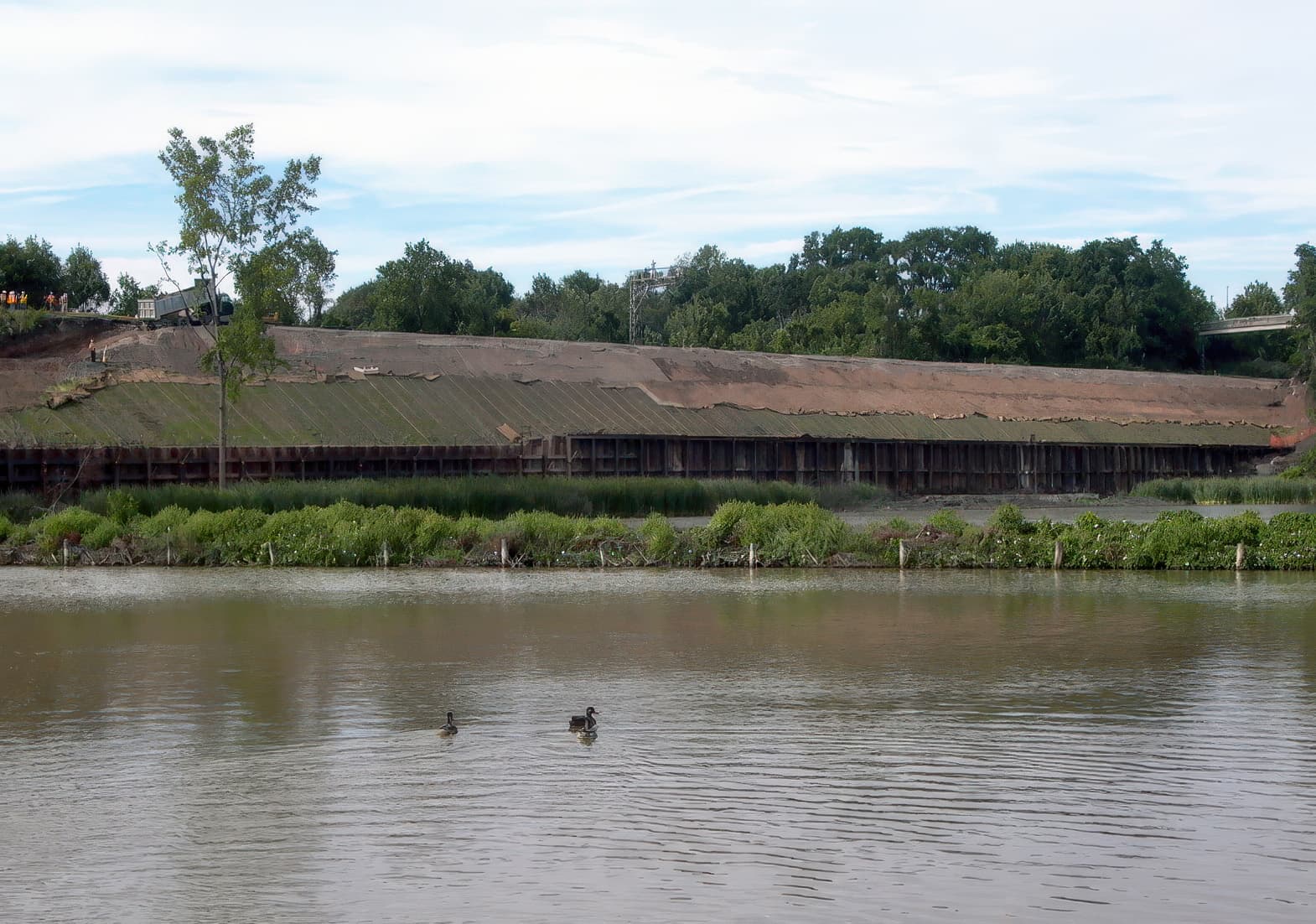
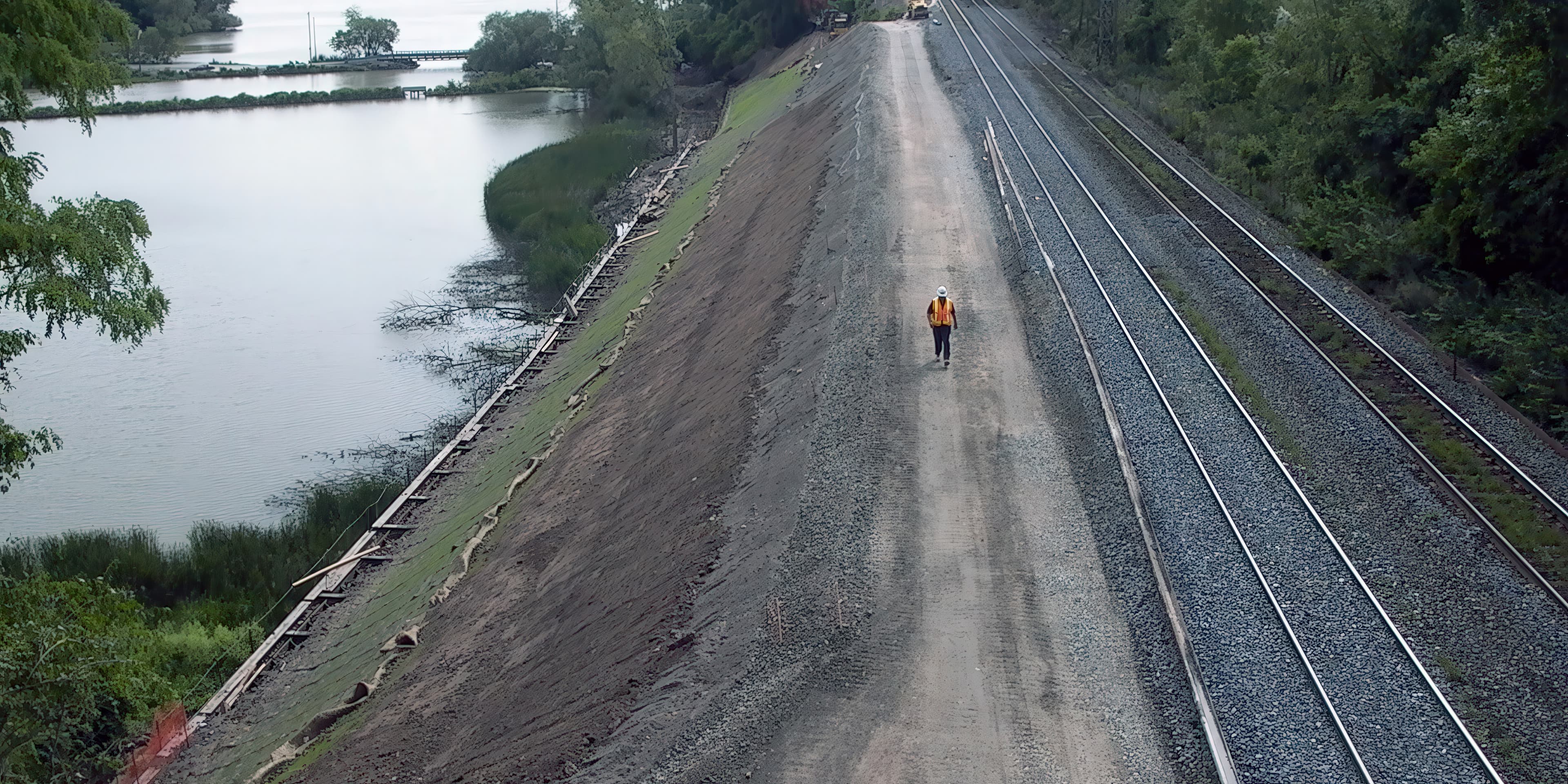
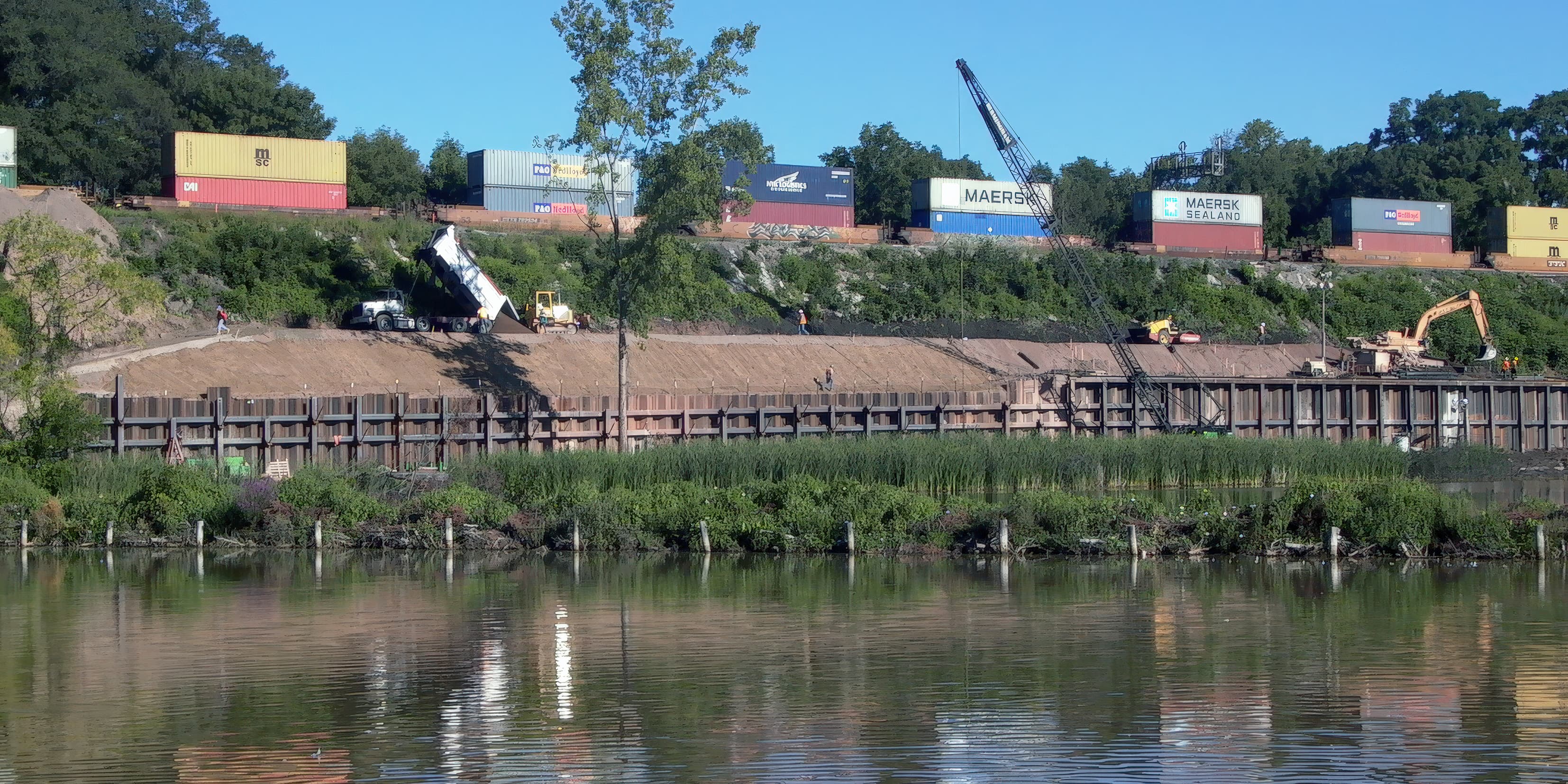
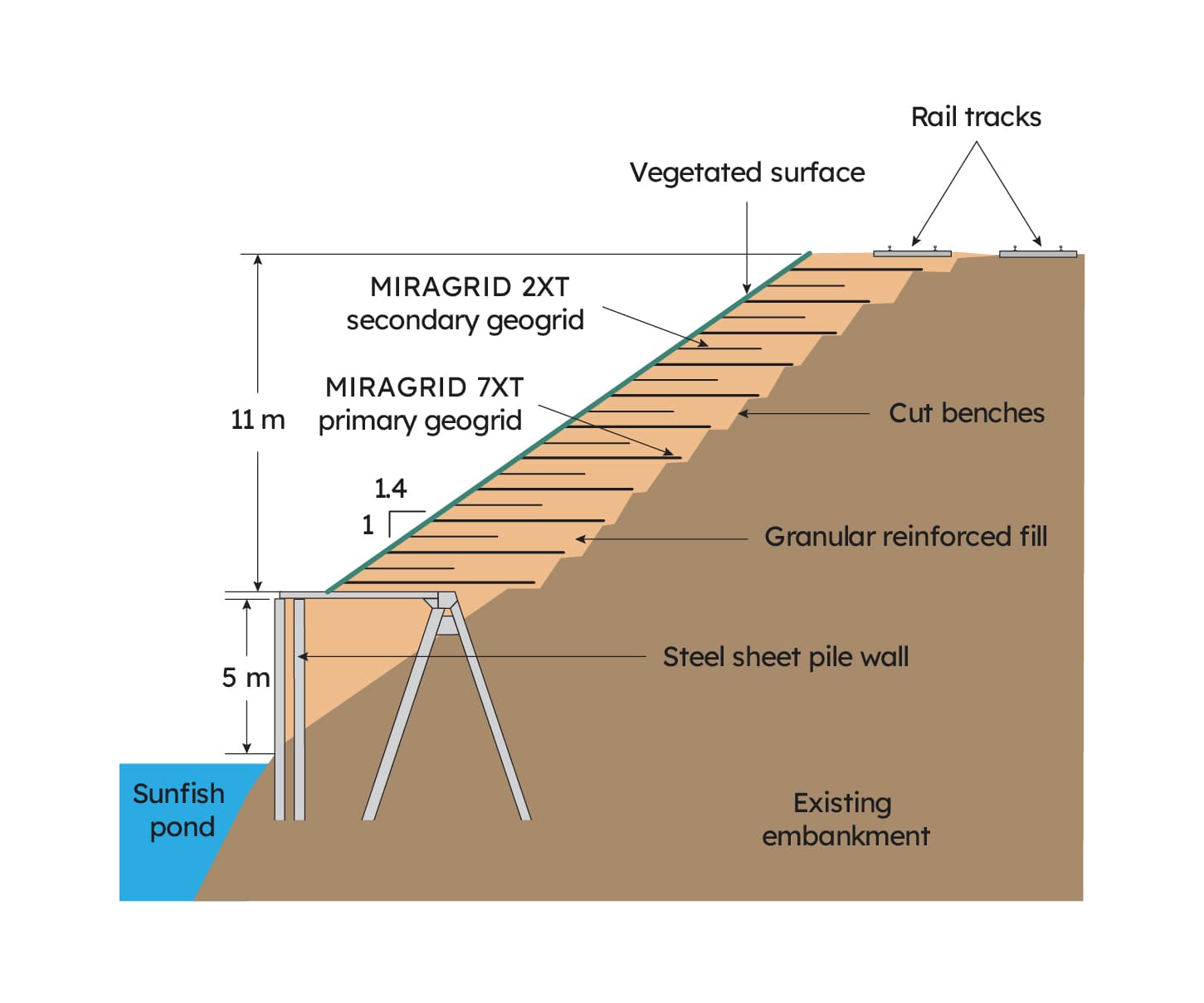
After evaluating a number of options, the solution chosen was a combined steel sheet pile wall with a vegetated geogrid reinforced slope on top. The sheet pile portion of the steepened embankment slope was tied back using earth anchors or battered piles (depending on the location). The 5 m high sheet pile wall was constructed immediately adjacent to Sunfish Pond. As the sheet pile wall was constructed, an earthworks contractor followed closely behind placing and compacting a specified granular fill behind the sheet pile wall. Above the sheet pile wall a 1V:1.4H geogrid reinforced fill slope was constructed along with a vegetated surfacing. The slope consisted of compacted granular fill with layers of MIRAGRID® GX geogrid reinforcement as the primary reinforcement placed at 1.0 m vertical spacings, extending 6 m into the slope. MIRAGRID GX geogrid reinforcement was used as the secondary reinforcement to provide local slope face stability, and these were installed at 1.0 m vertical spacings intermediately between the primary geogrid layers. The MIRAGRID GX secondary reinforcement layers extended 2.0 m into the slope face. MIRAGRID GX geogrid reinforcements are composed of high strength, high stiffness, polyester yarns encased within a robust polymer coating, and have ultimate tensile strengths of 90 kN/m and 35 kN/m respectively. In order to construct the new reinforced fill slope and obtain the necessary geogrid reinforcement embedment lengths, it was necessary to excavate into the existing embankment slope, which was subsequently nailed to provide temporary stability. After completion of the structural portion of the reinforced fill slope, the slope surface was covered with 100 mm of topsoil and then hydro-seeded with a mix of grasses. The slope surface was then covered with a geomat erosion protection layer to prevent erosion of the topsoil while vegetation was established, and to provide reinforcement for the vegetation’s root matrix. To prevent localized movement the geomat was stapled to the slope face at 1m intervals and was trenched into the toe of the slope to provide good stability. Full vegetation of the reinforced slope took around 3 weeks, which was very quick. Following this, the third rail track was constructed on top of the reinforced fill slope.