Overview
The Sino Iron Project was a large-scale magnetite iron ore project located at Cape Preston in Western Australia's Pilbara region. It was the largest planned magnetite project in Australia, with an estimated 2.2 billion tons (2 billion tonnes) of magnetite ore. The project had a tight schedule, with construction starting in mid-2008 and due for completion by the end of 2010. A crucial part of the project was the construction of a 30 km (18.6 miles) services corridor connecting the port to the mine site.
Challenge
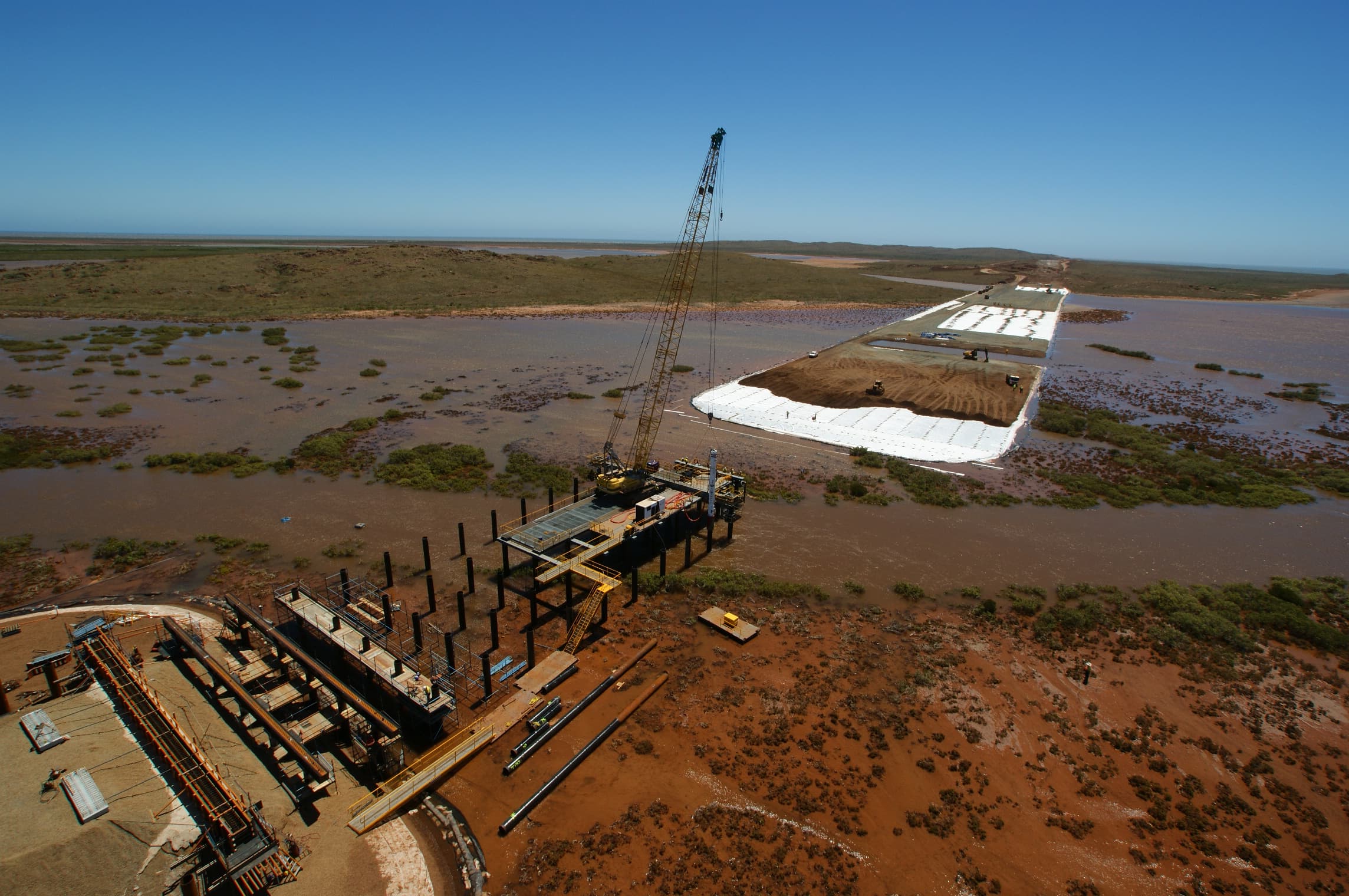
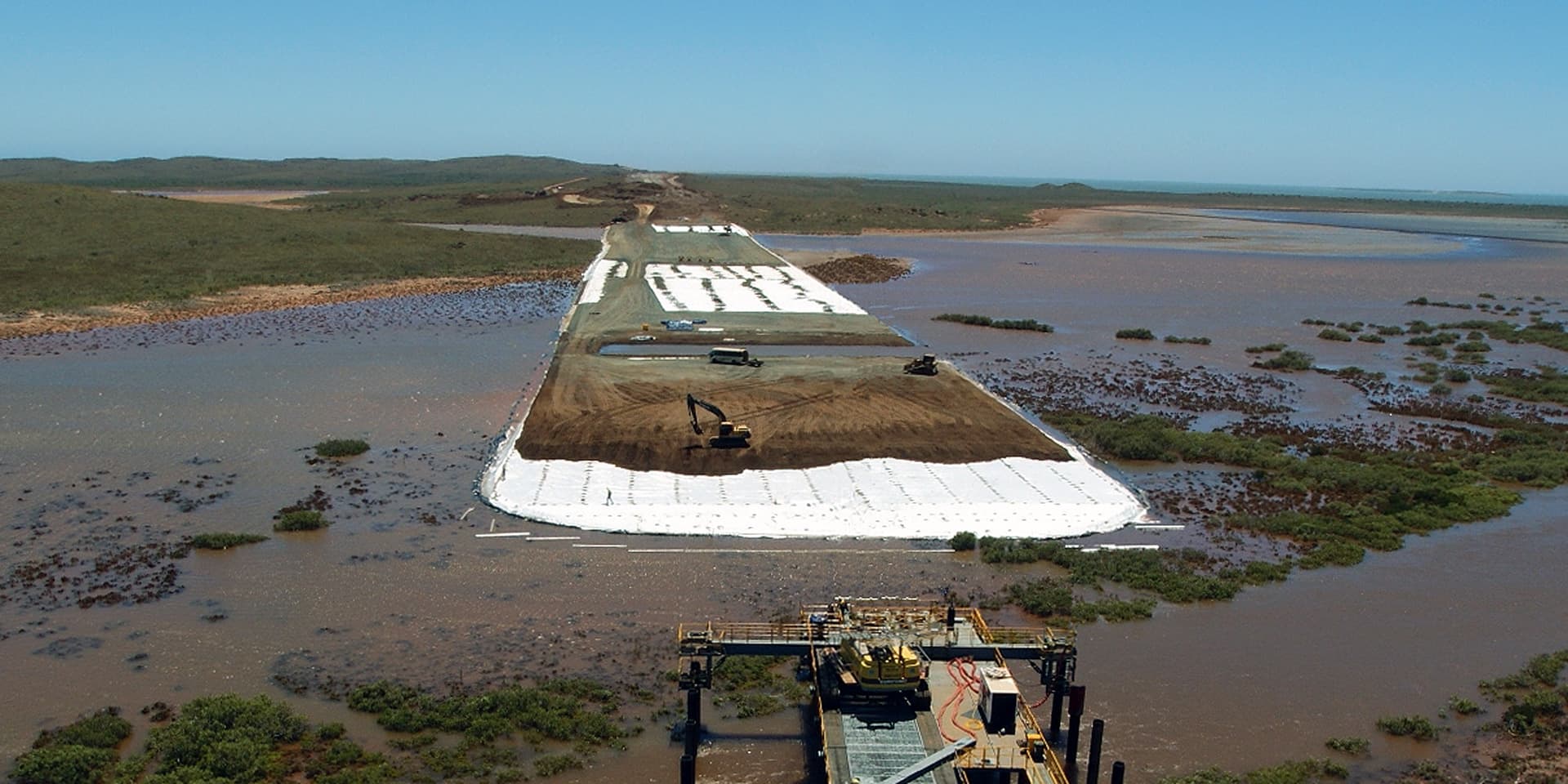
A 2km (1.2 miles) causeway had to be constructed through a river estuary as part of the services corridor. The estuarine mud foundation in the river estuary was soft to firm, posing challenges for construction. The foundation lacked the strength to support a 7m (23 feet) high rockfill embankment required for the project.
Solution
Several design and construction options were evaluated, considering environmental and safety requirements as well as the tight construction schedule. The chosen solution was to use three layers of MIRAFI® PET 800-50 geotextile reinforcement as basal reinforcement. This woven polyester geotextile had a tensile strength of 800 kN/m (180,000 lb/ft) at 10% strain and excellent resistance to creep.
The MIRAFI PET 800-50 geotextile reinforcement was placed directly on the surface of the soft estuarine mud. Rolls of geotextile were laid perpendicular to the embankment's direction, without any joins across the full width of the embankment. Mine waste rockfill was placed on top of the geotextile, forming an initial fill platform of 0.5m (1.6 feet) thickness. Another layer of geotextile reinforcement was added, followed by a 0.3m (1 foot) thick fill layer. Finally, a third geotextile layer was placed, and the embankment was constructed to its final grade alignment.
Result
The use of basal reinforcement allowed for the quick construction of the causeway embankment directly on the estuarine mud foundation, minimizing environmental impact. The services corridor was completed on schedule, and the settlement of the embankment was within the predicted value of 250 mm (9.8 in).